
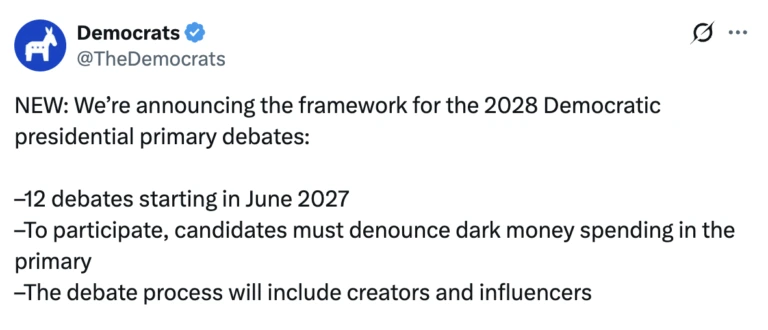
The DNC’s new policy would require candidates to publicly distance themselves from advertising purchased by super PACs and certain nonprofit organizations.
The requirements cover an extensive range of political advertising, including television, radio, digital campaigns, billboards and direct mail.
However, the rules go further than simply requiring candidates to reject advertisements attacking their opponents.

If an outside organization purchases advertising supporting a particular candidate, that candidate must condemn the expenditure. Meanwhile, if an organization launches an attack advertisement against a rival, the other candidates in the race would also be expected to denounce the spending.
In other words, Democratic presidential hopefuls could find themselves publicly criticizing political groups that are spending millions of dollars to improve their chances of winning.
There is one important distinction: The DNC is not actually preventing outside organizations from purchasing advertisements.
Instead, party officials are using access to the presidential debate stage as leverage. Candidates who refuse to comply with the pledge could find themselves excluded from the debates, potentially dealing a serious blow to their presidential ambitions.
Several prominent figures on the Democratic left have already expressed support for the proposal.
Sen. Elizabeth Warren of Massachusetts, Sen. Andy Kim of New Jersey and independent Sen. Bernie Sanders of Vermont have endorsed the pledge.
Their support could give the proposal additional credibility among Democratic voters who have long criticized the influence of wealthy donors and powerful political organizations.
Nevertheless, the policy raises questions about how the party will distinguish between legitimate independent political activity and spending that candidates are expected to publicly reject.
DNC Also Threatens Candidates Who Violate Primary Calendar
The financial pledge is only one part of the DNC’s broader effort to control the 2028 nomination process.
Party leadership is also moving to strengthen enforcement of its presidential primary calendar, warning candidates against campaigning in states that hold contests ahead of their officially approved dates.
Under the proposed framework, candidates who campaign in states that disregard the party’s calendar could face serious consequences.
Those penalties include exclusion from DNC-sponsored debates and losing eligibility to collect delegates from early primary contests.
The revised framework also makes it more difficult for party officials to reverse those penalties once they have been imposed.
The restrictions could become particularly significant if individual states attempt to move their contests forward to gain greater influence over the nomination process.
Presidential candidates routinely prioritize early-voting states because strong performances can generate momentum, media attention and financial support.
The DNC’s latest rules suggest that party officials intend to maintain tighter control over that process heading into the next presidential election.
New Restrictions on Campaign Fundraising
The pledge also contains provisions governing how candidates can coordinate financially with Democratic Party organizations.
Presidential hopefuls will be prohibited from entering joint fundraising agreements with Democratic Party committees until they become the presumptive nominee.
Additionally, candidates will be restricted from requesting or approving campaign advertisements financed by state and local Democratic Party committees before reaching that stage.
These provisions could limit certain fundraising and advertising arrangements during the primary, forcing campaigns to operate under a more restrictive set of financial guidelines.
For candidates attempting to build national organizations, such limitations could complicate their efforts to establish political relationships and expand their fundraising operations.
Twelve Debates Planned Across Two Election Years
The DNC intends to organize five presidential debates in 2027, followed by another seven in 2028.
The opening two debates are currently scheduled for June and July 2027. The final debate is tentatively planned for March 2028.
Party officials expect to announce the dates, locations, media partners and qualification requirements for the first two events in January.
Candidates hoping to participate will need to satisfy qualification standards that include polling performance and indicators of grassroots support, such as small-dollar fundraising.
The DNC is also preparing for the possibility of having too many candidates to accommodate on a single evening.
If an early debate requires two nights, the party will limit participation to a combined 20 candidates. The lineups will be determined randomly “in a manner that will ensure parity across both nights.”
The approach resembles the format Democrats used during their previous open presidential primary.
In June 2019, NBC News, MSNBC and Telemundo hosted the opening debate of the 2020 Democratic presidential campaign in Miami. Organizers divided the large field into two groups, with 10 candidates appearing each evening.
Social Media Influencers Could Become Part of the Debate Process
Perhaps one of the more unexpected elements of the DNC’s announcement involves its plans to incorporate social media influencers and online content creators into the debate process.
The party believes digital personalities could help attract younger audiences and generate additional attention for the presidential debates.
However, officials have provided relatively few details about exactly how these influencers will participate.
It remains unclear whether they will simply promote the events, interview candidates, participate in discussions or have some influence over the questions and issues presented to voters.
The proposal arrives as political campaigns increasingly rely on online personalities to reach audiences outside traditional television and newspaper coverage.
But the growing relationship between political organizations and paid internet personalities has also attracted scrutiny.
Shanna Ports, a campaign finance attorney with the Campaign Legal Center, raised concerns about the potential consequences of undisclosed political sponsorships.
Ports told ABC News that when online creators receive compensation for publishing political content without properly disclosing those arrangements, audiences may struggle to distinguish authentic political opinions from paid endorsements.
That concern could become particularly relevant if influencers are brought into a presidential debate operation that is supposed to provide voters with a fair opportunity to evaluate competing candidates.
Veteran Democratic Operatives Will Oversee the Process
The DNC has selected longtime party adviser Minyon Moore and Executive Director Roger Lau to lead the committee responsible for organizing the debates.
The planning group includes individuals with experience working on presidential campaigns for Kamala Harris, Joe Biden, Bernie Sanders, Elizabeth Warren, Amy Klobuchar, Hillary Clinton and Barack Obama.
The selection brings together operatives who have worked across multiple Democratic presidential campaigns, including several of the party’s most influential political figures.
DNC Chairman Ken Martin defended the preparations, presenting the new framework as an opportunity to strengthen the party ahead of another presidential election.
“Democrats are on offense after our historic victories in the midterms, and the DNC is keeping our foot on the gas as we head into the 2028 cycle,” DNC Chair Ken Martin said in a statement.
“The fair and transparent process and experienced leadership team we’re announcing today will keep our party united, strengthen our eventual nominee, and put Democrats in position to take back the White House.”
Still, the new requirements could create an unusual dynamic during the Democratic primary.
Candidates will be competing against one another for the nomination while simultaneously navigating a party-imposed system that restricts their fundraising relationships, regulates their campaign activity in early states and requires them to publicly criticize certain outside political expenditures.
With the 2028 presidential race approaching, the DNC is making clear that securing the nomination will involve more than winning over voters.
Candidates will also have to satisfy a growing list of demands from the party organization controlling access to the debate stage.

