
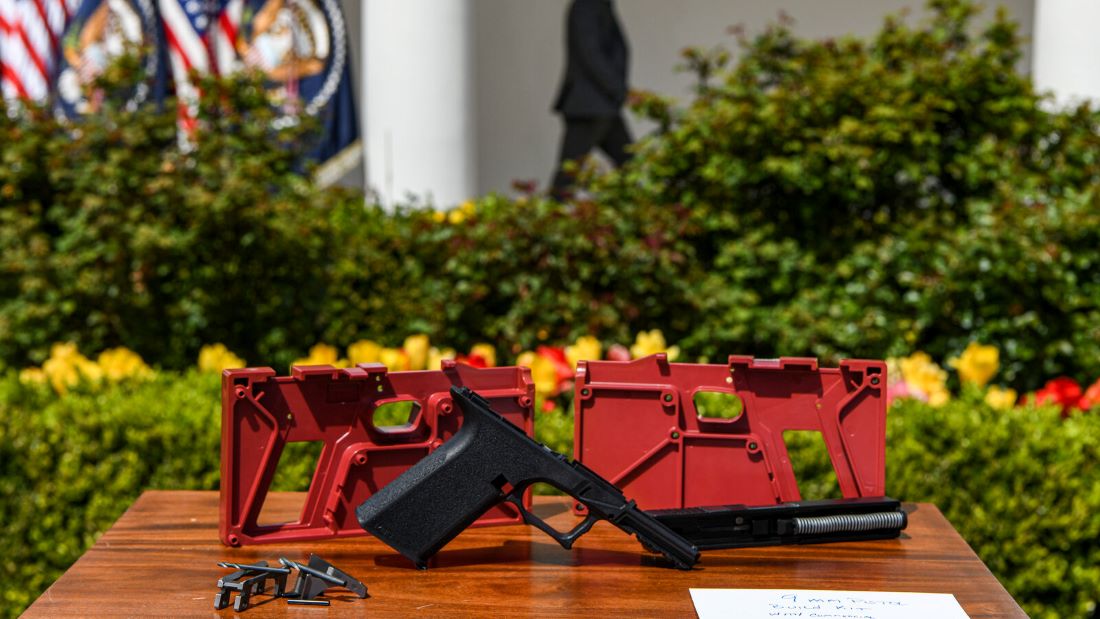
On Thursday, a federal appeals court called into question a regulation that the Bureau of Alcohol, Tobacco, Firearms and Explosives had put in place to take tough measures against “ghost guns.”
A three-judge panel from the esteemed 5th U.S. Circuit Court recently ruled. The Circuit Court of Appeals has ruled that a 2022 rule that attempts to address the problem of guns made from parts that are purchased online without going through background checks is more than the authority given to the relevant agency.
Don’t miss this! Carry faith with you everywhere with the Exclusive National Prayer Coin!

According to Reuters, former President Donald Trump appointed each and every judge on the panel.
The recent decision, in the opinion of attorney Cody Wisniewski of the Firearms Policy Coalition Action Foundation, represents a major victory against the ATF and a serious setback to the Biden administration’s gun control agenda.
This rule redefined the legal definitions of “firearm,” “frame,” and “receiver” as they appeared in the Gun Control Act of 1968.
Judge Kurt Engelhardt stressed in his ruling that the legislative branch alone has the power to enact laws and turn them into binding obligations.
“Where an executive agency engages in what is, for all intents and purposes, ‘law-making,’ the legislature is deprived of its primary function under our Constitution, and our citizens are robbed of their right to fair representation in government. This is especially true when the executive rule-turned-law criminalizes conduct without the say of the people who are subject to its penalties,” he wrote.
Engelhardt claims that the rule accomplishes what Congress may wish to accomplish but hasn’t yet done.
“The agency rule at issue here flouts clear statutory text and exceeds the legislatively-imposed limits on agency authority in the name of public policy,” he wrote.
ALERT! Major Water Restrictions In Effect!
He made it clear in his statement that the ATF had overreached itself in attempting to play a legislative role in gun control. It is crucial to keep in mind that an executive agency is not tasked with drafting laws for our nation.
“An agency cannot label conduct lawful one day and felonious the next—yet that is exactly what ATF accomplishes through its Final Rule,” he wrote.
In his concurring opinion, Judge Andrew Oldham delivers a harsh indictment of the ATF.
“ATF’s overarching goal in the Final Rule is to replace a clear, bright-line rule with a vague, indeterminate, multi-factor balancing test. ATF’s rationale: The new uncertainty will act like a Sword of Damocles hanging over the heads of American gun owners,” Oldham wrote, alluding to an old folktale in which a lethal blade was held aloft by a single horsehair strand.
“Private gunmaking is steeped in history and tradition, dating back to long before the Founding. Millions of law-abiding Americans work on gun frames and receivers every year. In those pursuits, law-abiding Americans (and the law-abiding gun companies that serve them) rely on longstanding regulatory certainty to avoid falling afoul of federal gun laws,” he wrote.
“But if ATF can destroy that certainty, it hopes law-abiding Americans will abandon tradition rather than risk the ruinous felony prosecutions that come with violating the new, nebulous, impossible-to-predict Final Rule,” he wrote.
The author attacked the ATF rule in a concise and forceful statement, emphasizing its wide reach and intent to control any altered metal or plastic item that might be used to make firearms. The author drew attention to the fact that the rule is in effect indefinitely, unless the substance melts and crosses the limits established by the GCA. In the end, the author agreed with the majority ruling that declared the Final Rule unconstitutional.
Despite the decision, it is anticipated that the rule will be in effect for some time to come.
The Hill reports that the Justice Department is expected to appeal the most recent ruling to the Supreme Court, which is expected to follow its precedent of upholding this rule in court.

