
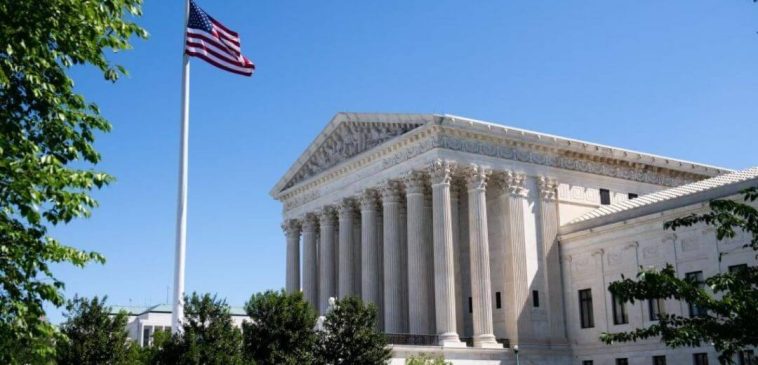
In a significant decision this Thursday, the U.S. Supreme Court has upheld a controversial tax measure from the Trump administration. The 2017 tax law, which was aimed at funding President Trump’s substantial tax cuts, has survived a legal challenge led by taxpayers Kathleen and Charles Moore. The Moores contested a hefty $14,729 tax bill tied to their investments in a foreign company, arguing that they did not profit from the venture and that the tax violated their constitutional rights under the 16th Amendment. However, the Supreme Court, in a 7-2 vote, determined that Congress acted within its legal boundaries when it imposed the Mandatory Repatriation Tax (MRT) on U.S. shareholders of foreign companies.
The court’s decision stated, “The MRT—which attributes the realized and undistributed income of an American-controlled foreign corporation to the entity’s American shareholders, and then taxes the American shareholders on their portions of that income—does not exceed Congress’s constitutional authority.” This ruling emphasizes that the tax is constitutionally sound as it only affects the shareholders’ income from foreign entities that has not been previously taxed.
Grab Your Shipment of $100 Gold Bar…. for FREE – Only for Patriotic Americans!

Justice Brett Kavanaugh, writing for the majority, highlighted the specificity of the ruling, explaining it as a targeted approach to taxation concerning undistributed earnings attributed to shareholders of entities that themselves have not been taxed. “In other words, our holding applies when Congress treats the entity as a pass-through,” Kavanaugh elaborated.
>> Click Here To Continue Reading <<

