
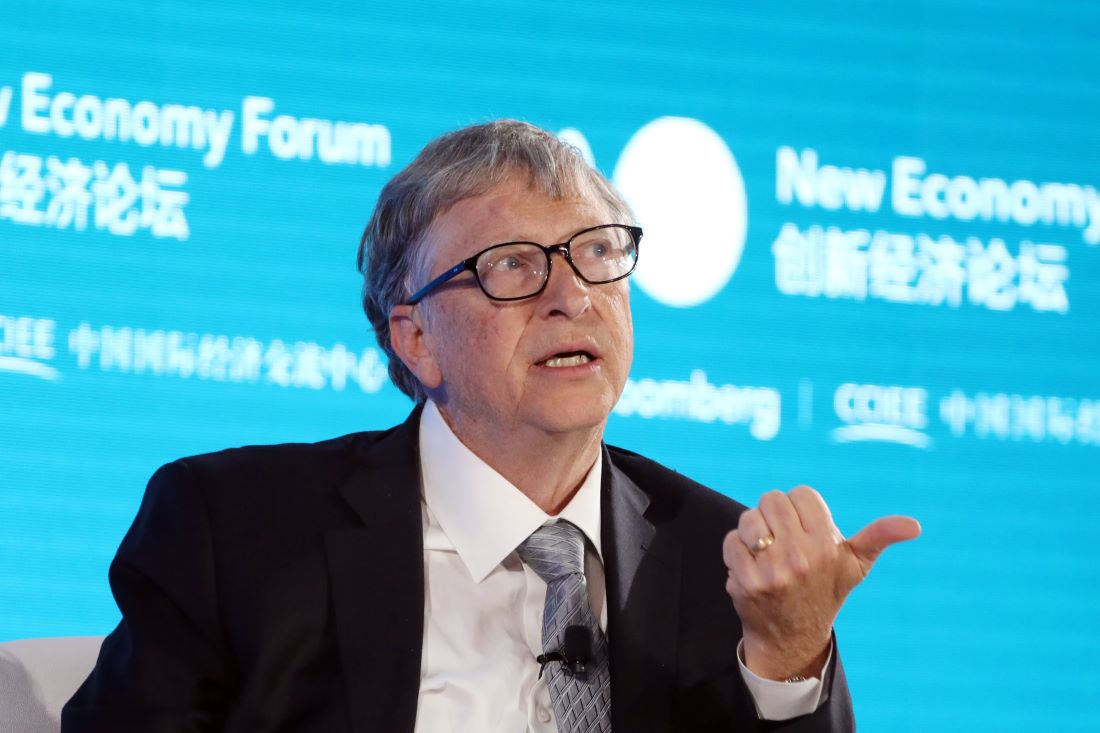
Despite having an estimated $7 billion in wealth, climate change skeptic Bill Gates looks to be changing his mind.
“There’s a lot of climate exaggeration,” said Gates at a recent event. “The climate is not the end of the planet. So the planet is going to be fine.”

Gates delivered a powerful speech at the Earthshot Prize Innovation Summit among other distinguished visitors like British Prince William and billionaire Michael Bloomberg.
Days later, Gates delivered a wise comment about climate change at a New York Times event. Although the effect on humanity is evident, he asserts that the earth may be less impacted. He further promised that no moderate nation would be made uninhabitable.
At the NY Times event, Gates highlighted that enforcing climate policy by global leaders is not a viable option.
“If you try to do climate brute force, you will get people who say, ‘I like climate but I don’t want to bear that cost and reduce my standard of living,’” Gates remarked. “Without innovation, it’s unlikely, particularly in middle-income countries, that the brute force approach will be successful.”
He didn’t give specifics, but he highlighted that all political parties must work together to push climate change legislation more vigorously.
“You can’t have a climate policy that when one party is in charge goes full speed ahead and stops cold,” he said. “These are 30-year investments in steel factories.”
“It’s pretty clear we’re not going to go to extreme scenarios,” he added. “Emissions will peak and then start to go down. They won’t go down as fast as we want them to and so the temperature will continue to rise and once the temperature has risen it doesn’t go down very quickly, unless you do massive carbon removal.”
REVEALED: The 3 reasons you should NEVER use Vegetable Oils…
Mr. Gates assertively identified himself as a driving force in the fight against climate change at a recent NY Times event, reiterating his dedication to innovation and the pursuit of numerous objectives. He provides evidence for his assertion by making substantial financial contributions to the cause.
Mr. Gates anticipated that by 2020, climate change would result in more fatalities and hardships than the existing COVID-19 issue in one of his earlier pronouncements about it. He highlighted that, despite the pandemic’s intensity, climate change has the potential to be considerably more disastrous. He emphasized the necessity of stepping up efforts to stop a climate catastrophe, pleading with world leaders to act right away.
The most significant private owner of agricultural property in the United States is the famed billionaire Bill Gates. Over the past five years, he has collected an astonishing collection of farms. Gates has actively advocated for alternatives to conventional farming practices, such as synthetic or plant-based meat, because he is deeply concerned about the negative environmental effects of those practices. Gates wants to alleviate the detrimental effects of conventional agriculture on the environment by encouraging these cutting-edge methods.
John Clauser, a renowned scientist and Nobel Laureate, raises important questions regarding the reliability of climate models. He underlines the importance of a vital component that scholars have overlooked. In a pledge that challenges the idea of a “climate emergency,” more than 1,600 eminent scientists, including Clauser, have come together to support his position. Their collective stance emphasizes the significance of historical evidence, showcasing that the Earth’s climate has consistently fluctuated over time, with or without human influence.
“In addition, [climate models] ignore the fact that enriching the atmosphere with CO2 is beneficial,” their declaration said.
Additionally, they contend that mainstream scientists create a “popular narrative” that is actually a “distortion of science” with grave ramifications for the welfare of countless people around the world.
“Misguided climate science has metastasized into massive shock-journalistic pseudoscience. In turn, the pseudoscience has become a scapegoat for a wide variety of other unrelated ills,” it added. “It has been promoted and extended by similarly misguided business marketing agents, politicians, journalists, government agencies, and environmentalists. In my opinion, there is no real climate crisis.”
“There is, however, a very real problem with providing a decent standard of living to the world’s large population and an associated energy crisis. The latter is being unnecessarily exacerbated by what, in my opinion, is incorrect climate science.”
Prior to this, two esteemed researchers from Princeton and MIT had issued a dire warning on future EPA rules intended to reduce carbon dioxide emissions from power plants. They claimed, without any solid scientific support, that these regulations would have disastrous effects on the country in their testimony in August.
“The unscientific method of analysis, relying on consensus, peer review, government opinion, models that do not work, cherry-picking data and omitting voluminous contradictory data, is commonly employed in these studies and by the EPA in the Proposed Rule,” William Happer, professor emeritus in physics at Princeton University, and Richard Lindzen, professor emeritus of atmospheric science at MIT, wrote. “None of the studies provides scientific knowledge, and thus none provides any scientific support for the Proposed Rule.”
Famous climate scientist Dr. Judith Curry, who had previously sided with the alarmist viewpoint, has had a paradigm shift that has led her to refute the idea that there is a widespread “climate emergency.”
Curry describes how the 2009 ClimateGate affair fundamentally altered her view of academia’s contribution to the creation of the narrative surrounding the climate crisis.
Dr. Curry discussed her paradigm shift of perspective after diving deeply into the subject of climate change during an interview with renowned independent journalist John Stossel. She found the substantial influence that radical groups and anti-capitalist factions had on this matter by using it to further their own political objectives.
As public opinion turns against extreme hyperbole about the climate issue, The New York Times shuts comments on a Bill Gates interview.

