
The American Lung Association has issued a particularly sobering warning about the dangers associated with lead exposure.
“There is no known safe level of exposure to lead,” the organization states.
“Exposure to lead can harm nearly every system in the body. Lead accumulates in the bones, liver, and kidneys and can get into the blood. The effects of lead poisoning may continue after the source of exposure has been eliminated.”

Those warnings have prompted recommendations that residents take precautions even after the detonation has been completed.
Among the measures suggested by the American Lung Association are keeping windows and doors shut for at least 48 hours, using HEPA-filtered vacuums to clean carpets, and considering temporary relocation for pregnant women and households with children if they are located within the projected fallout area.
The organization also recommends wearing N95 masks when cleaning outdoor surfaces to reduce the risk of inhaling contaminated particles.
In other words, this is not an ordinary military disposal operation that residents can simply ignore.
The Washington Post’s staff writer Grey Battle also highlighted the Army’s evacuation plans and the potential dangers associated with the explosion.
“Evacuate,” Battle urged, explaining that the military intends to clear residents from a five-mile-wide area extending southwest of the installation, along with an additional mile beyond the anticipated dispersion route.
The health concerns are significant.
Battle noted: “In the human body, lead can affect behavior, harm cognition, and interfere with fetal brain development. For pregnant women, it increases the risk of premature birth and miscarriage.”
The report also outlined symptoms associated with substantial lead exposure over a relatively short period.
“Symptoms of high lead exposure in a short period of time include metallic taste, abdominal pain, nausea, vomiting, diarrhea or constipation, dehydration, appetite loss, memory loss, and pain or tingling in hands and feet, according to the Centers for Disease Control and Prevention,” Battle continued.
Longer-term exposure could also affect behavior and mood while contributing to elevated blood pressure.
That is hardly the sort of news Midwestern families want to receive immediately before one of America’s most cherished holidays.
Instead of spending Thanksgiving Eve preparing meals, welcoming relatives, and getting their homes ready for visitors, residents in the affected region could be forced to monitor government advisories and follow instructions designed to minimize potential exposure to toxic dust.
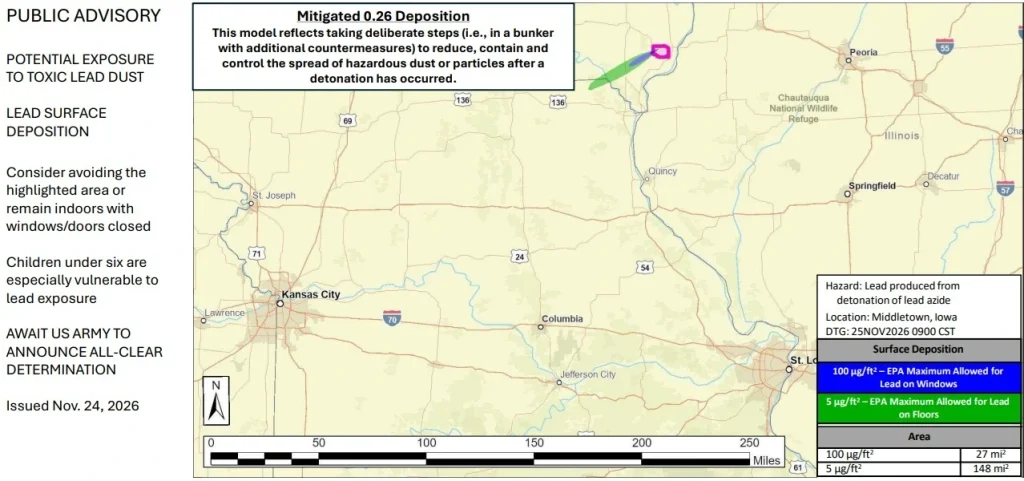
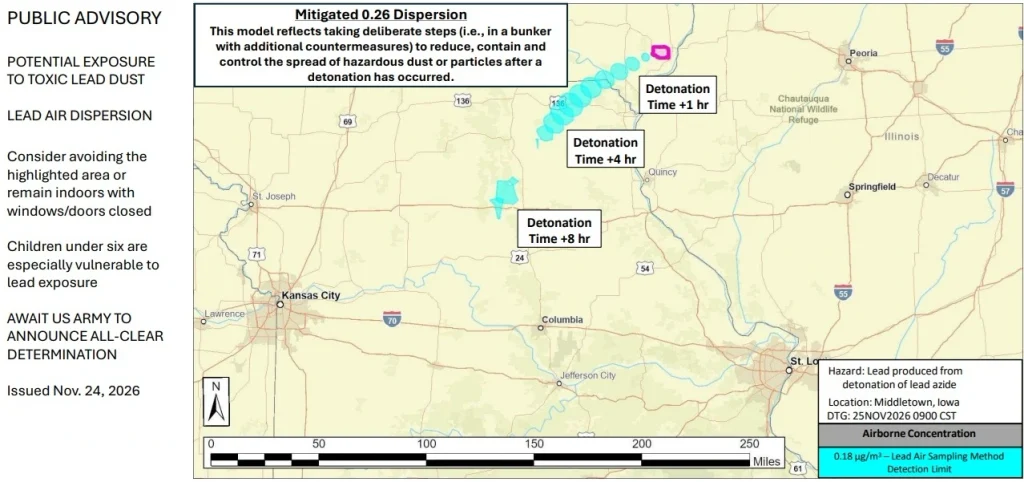
An Army public advisory reportedly warned residents about “POTENTIAL EXPOSURE TO TOXIC LEAD DUST…produced from detonation of lead azide.”
The accompanying guidance urged people to avoid highlighted areas or remain indoors with their windows and doors closed.
It also emphasized the particular vulnerability of children under six years old and instructed residents to wait for the military to issue an official all-clear.
“AWAIT US ARMY TO ANNOUNCE ALL-CLEAR DETERMINATION.”
The projected contamination area reportedly encompasses approximately 148 square miles across Iowa and Missouri. The potential consequences, however, could extend well beyond the immediate evacuation zone if residents become concerned about airborne contamination.
The timing could hardly be worse.
Thanksgiving travel, family gatherings, Black Friday shopping, and the beginning of the Christmas shopping season are all taking place during a period when residents may be instructed to remain indoors and exercise extraordinary caution.
Even Americans living outside the immediate danger zone could become concerned about whether the explosion will affect their communities.
For the Trump Administration, the controversy also presents an avoidable political headache.
The president has repeatedly emphasized putting American communities first. An operation that leaves ordinary citizens worrying about toxic exposure immediately before a major national holiday is certain to invite criticism, regardless of the military’s intentions.
The possibility of lawsuits adds another dimension to the controversy.
If residents later experience medical problems that they believe are connected to the detonation, the federal government could face years of legal challenges. Questions about potential long-term health effects, environmental contamination, and the government’s decision-making process could become central issues.
Even residents who never develop medical complications may question whether officials adequately considered the risks before proceeding.
The central question is straightforward: Why is detonating five tons of lead azide considered the best available option?
According to the Washington Post: “Officials have acknowledged the hazard but say they have no better option for disposing of the degrading, highly volatile lead azide.”
That explanation is unlikely to satisfy residents who are being asked to accept the consequences of an operation involving a substance known to pose serious health risks.
The Pentagon possesses enormous technical resources, sophisticated research facilities, and some of the country’s most accomplished engineering personnel. Surely, critics argue, officials should exhaust every conceivable alternative before choosing a disposal method that could expose surrounding communities to hazardous material.
Several alternative approaches have been proposed, including isolating the material in a heavily engineered underground containment facility, permanently encapsulating it in concrete, or transporting it to an appropriate secured military disposal site.
One suggestion involves constructing a reinforced underground storage structure, surrounding the hazardous material with layers of protective concrete and sealing it beneath the surface.
Another proposal envisions permanently encapsulating the material before placing it in an appropriately licensed deep-disposal facility.
A third suggestion points toward remote government-controlled testing grounds, where hazardous military materials might potentially be managed without placing populated communities at risk.
These suggestions would require extensive technical and environmental review. None should be assumed safe or practical without expert evaluation. Nevertheless, they raise an important question that deserves a serious answer: Have officials genuinely exhausted safer disposal alternatives?
The military should be able to explain why the selected approach is necessary, what environmental modeling supports the decision, and what safeguards are in place to prevent contamination beyond the installation.
Residents deserve more than reassurances that everything will be fine.
They deserve transparency about the projected fallout area, the monitoring process, the potential health consequences, and the precise conditions that must be met before authorities declare the area safe again.
The broader political consequences could also prove damaging.
Rural Americans who support the president expect the federal government to protect their communities, not place them in situations where they must worry about toxic exposure while preparing to celebrate Thanksgiving.
The administration is already confronting numerous national challenges, from transportation disruptions and cybersecurity threats to growing concerns about foreign espionage. The last thing it needs is another controversy that could have potentially been avoided through better planning and communication.
Ultimately, the issue is bigger than partisan politics.
The people living near the Iowa ammunition facility are American citizens. They should not have to choose between celebrating Thanksgiving with their families and worrying about whether hazardous military waste could contaminate the air around their homes.
If the Army truly has no viable alternative, officials owe the public a detailed explanation backed by credible scientific evidence.
But if safer disposal options exist, the administration should seriously reconsider its approach before proceeding.
Five tons of lead azide are already a significant disposal challenge. Turning the operation into a nationwide political and public-health controversy would only make matters worse.
Thanksgiving should be about family, gratitude, and enjoying time together — not waiting for the federal government to announce that it is finally safe to open the windows.
Deroy Murdock is a Manhattan-based Fox News Contributor.

