

>> Continued From the Previous Page <<
On January 3, Taiwan’s Chungwha Telecom reported an outage in its TPE cable, a vital link operated in partnership with global telecom giants like AT&T, Verizon, and China Telecom. The damage occurred just outside Taiwan’s territorial waters near Keelung, a major northern port.
Suspicion quickly fell on the Hong Kong-owned, Cameroon-registered freighter Shunxing39, flagged by Taiwan’s Coast Guard Administration (CGA) as the likely culprit. Attempts to board the vessel were thwarted by rough seas, and the ship has since turned off its Automatic Identification System (AIS), making it harder to track.

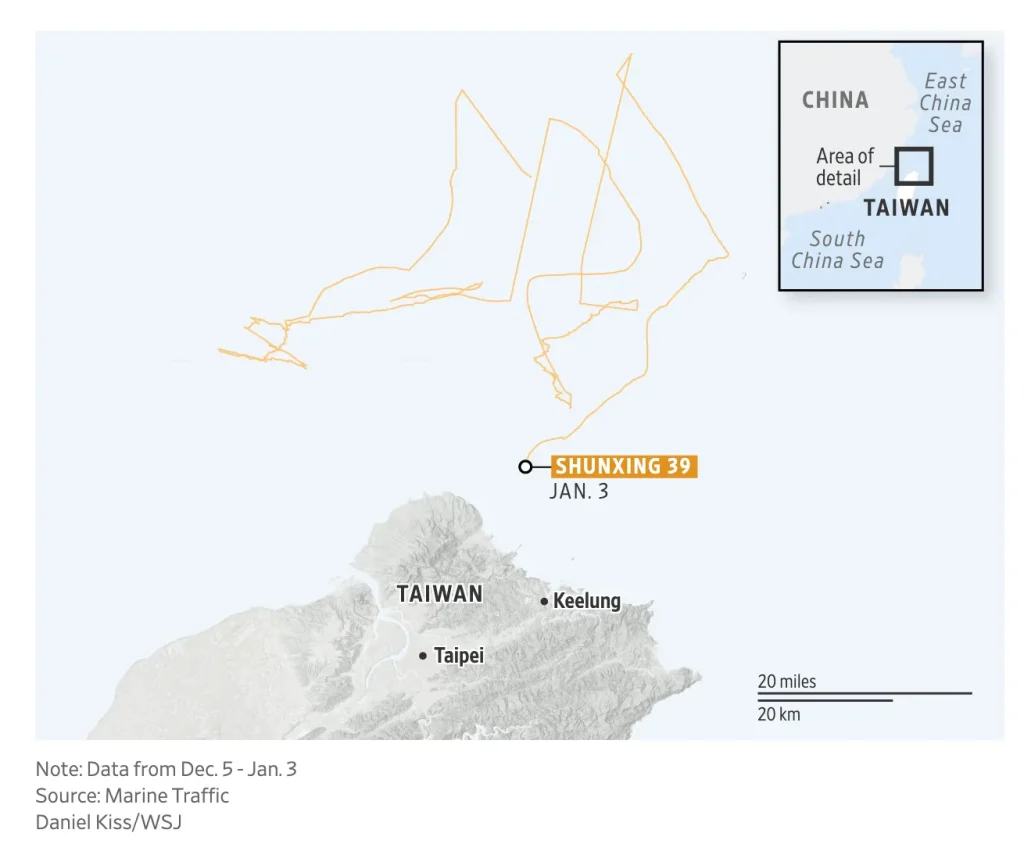
Ray Powell, director of Stanford University’s Sealight project, noted that the Shunxing39 has operated under “two different names, two different flags, and six different identification numbers over the last six months.” He added, “Having at least six different registration numbers indicates this ship is devoted to being off-grid or hard to track…it’s hidden behind a private company based out of Hong Kong with an owner in China and flags of African countries, which keep the Chinese government from the vessel’s activities.”
Experts warn that this sabotage may be the precursor to a larger operation. Analysts from INDSR have likened the scenario to the Cuban Missile Crisis, where China could implement a “quarantine” rather than a blockade to cut Taiwan off from the outside world.
Such a tactic would be a calculated risk. While a blockade is considered an act of war, a “quarantine” might allow China to sidestep outright conflict, creating a naval barrier under the guise of inspecting vessels.
The situation grows more tenuous as South Korea, a potential ally in countering Chinese aggression, grapples with internal political instability. The strained relations between South Korea’s Chinese-leaning Democratic Party and its Conservative Populist People Power Party further complicate regional unity against China.
Former President Donald Trump’s impending return to office has fueled hope for a robust response to China’s escalating aggression. Trump has consistently advocated for rebuilding the U.S. Navy, lamenting the decline of America’s shipbuilding capabilities during the Biden administration.
KICK OUT The Cold and Say Hello to The Handyheater! Warming Any Spot INSTANTLY!
“We used to build a ship a day. We don’t build ships anymore. We want to get that started… China’s building, from what I’m hearing, every four days, they’re knocking out a ship,” Trump stated in an interview with Hugh Hewitt.
Hewitt emphasized Trump’s commitment, labeling him a “Navalist” in the tradition of Teddy Roosevelt and Ronald Reagan. Trump’s focus on strengthening the Navy contrasts sharply with what he described as the Biden administration’s “Green New Deal nonsense.”
As Taiwan faces this escalating crisis, the stakes have never been higher. The sabotage of its undersea cables is not just an attack on its infrastructure but a bold challenge to global stability. With Trump’s return to power, his administration’s response to these provocations could redefine U.S. leadership in the Indo-Pacific region.
The clock is ticking, and Taiwan’s fight to maintain its sovereignty hangs in the balance.

