
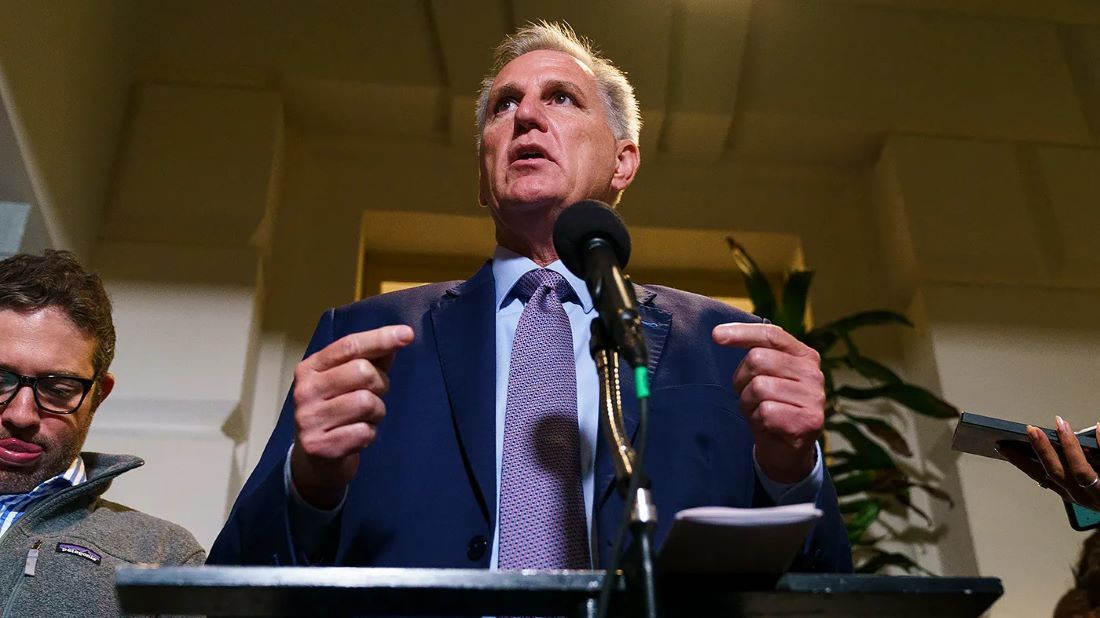
Speaker Kevin McCarthy is reconsidering his decision to exclude funding for Ukraine from a crucial package for military expenditure. Republicans are currently attempting to determine how to proceed with funding for the government.
Following GOP opposition, a California Republican changes his mind on assistance for Ukraine. McCarthy initially intended to cut the Pentagon budget by $300 million, but he ran into opposition from inside his own party.

On Saturday, McCarthy said the bill would move forward with the Ukraine aid as scheduled. He stated that doing away with it would be too difficult given the Republican Party’s funding scheme. After two recent failures, this choice raises additional concerns about whether the Pentagon budget measure will be considered.
“It became too difficult to do that, so we’re leaving it in,” McCarthy spoke with reporters about the Ukraine funding.
Republicans are getting ready for a critical vote on Tuesday that will launch the conversation on four important bills for funding the government. Important topics including defense, state, homeland security, and agriculture are all covered by these bills. McCarthy is making a crucial step here to advance his party’s financial demands. The result is still up in the air, especially in light of recent developments involving aid to Ukraine. It’s still not apparent if they have enough support to move on. Even if they succeed in beginning the discussion or passing any of the four legislation, it won’t stop the anticipated shutdown, which is set to start on October 1.
Republican Majority Whip Tom Emmer (R-Minn.) is urging his fellow party members to express their opposition to bringing the legislation to the floor, but uncertainty still lurks. Emmer’s call emphasizes the significance of telling leadership about their intentions by pointing out that a formal vote check for procedural measures is not typically done.
“We’ll see if we get there,” Rep. Erin Houchin (R-Ind.), a member of the Rules Committee, commented on the vote to start the discussion on Tuesday.
The House GOP’s approach to supporting Ukraine is proving to be very unpredictable. Their capacity to control the situation has been severely constrained by their thin majority and the members’ frequent absences.
Republicans attempted to influence Rep. Marjorie Taylor Greene’s support on the Defense bill by withholding money to Ukraine. Greene had already objected to starting the bill’s debate.
REVEALED: The 3 reasons you should NEVER use Vegetable Oils…
Rep. Matt Gaetz (R-Fla.) and other hardliners, however, were the subject of a bigger agreement that involved bringing the bill to the floor along with funding for the State Department and other organizations. Given that the State bill also included monies relating to Ukraine, this presented a fresh challenge for Greene. Given the connection between these proposals, it was likely that the Georgia Republican would oppose their introduction regardless of what happened to the Pentagon budget bill.
McCarthy explains why he thinks she will reject the rule. He made an effort to come up with a solution that would allow for participation from everyone, but it was unsuccessful.
Instead of just cutting it out of the Defense measure and having a separate vote, Republicans decide to obtain Ukraine aid by calling for a floor vote to withdraw funding from both the State and Defense budgets. With Democrats’ support, this strategy ensures that the funds will be maintained.
Republicans are confident in their plan to persuade holdouts like Gaetz who oppose a temporary budget agreement to avert a shutdown to back larger funding legislation.
After the conference call on Saturday, McCarthy’s supporters spoke to the media. One of the holdouts, Rep. Matt Rosendale (R-Mont. ), however, reiterated firmly his objection to a short-term bill known as a continuing resolution.
McCarthy offers a GOP border measure, a debt commission, and a 30-day funding bill. He recently discussed the potential of extending the funding patch to 45 days during a conference call with his members, allowing the House more time to pass annual budget bills and conduct negotiations with the White House and Senate.
McCarthy, the head of the Republican Party, offers an answer in response to criticism from conservatives. Instead of depending on a 30-day stop-gap bill that lacks Democratic support, McCarthy advises focusing on passing larger financing legislation with bipartisan support.
McCarthy supporter Rep. Garret Graves (R-La.) denounced this effort as a “counterproductive strategy,” highlighting the impossibility of passing all spending bills by the end of the month.
“We’re in a situation right now … where the arsonists are out there, number one, whining that their house is on fire. Number two, are going to want credit that they put the fire out. And then number three, they’re going to set up a GoFundMe site to get paid,” Graves said.

