
>> Continued From the Previous Page <<
The complaint centers on claims that the event benefits both President Trump and UFC leadership financially and politically, pointing in particular to Trump’s reported purchase of up to $50,000 in stock in TKO Group Holdings, the UFC’s parent company. Plaintiffs argue this creates a conflict of interest and raises ethical concerns about the use of the White House grounds for such a spectacle.
The legal challenge includes plaintiffs such as a political activist known for organizing demonstrations near the Lincoln Memorial and a Vietnam War veteran, Paul Romano. The filing requests an emergency restraining order to prevent the UFC event from moving forward, with the case assigned to Judge Amit Mehta, an Obama-era judicial appointee.

However, supporters of the event argue the lawsuit ignores key facts about its public nature. Organizers have stated that approximately 85,000 free tickets will be distributed for viewing areas near the Ellipse, ensuring that ordinary Americans—not corporate elites—can attend. Military families are also expected to receive priority seating arrangements inside designated areas on the South Lawn.
In addition, weigh-in events are planned to take place at the Lincoln Memorial, further reinforcing the organizers’ framing of the event as a national celebration rather than a private commercial showcase. Critics of the lawsuit argue that these details directly contradict claims that the event is exclusionary or purely profit-driven.
The White House itself has responded sharply, describing the legal filing as “obstructionist, baseless, and dilatory.” Officials also pointed out that large-scale public events are routinely held on the South Lawn, the Ellipse, and the National Mall with proper permitting and longstanding precedent.
At the center of the political controversy is not just the legal argument, but the symbolism of the event. The planned fights include high-profile UFC athletes such as Ilia Topuria and Justin Gaethje competing for a lightweight title in front of a massive live audience. For supporters, the imagery of combat sports at the nation’s most iconic residence represents a bold, populist celebration of American culture.
Dana White, CEO of UFC, has been blunt about the criticism surrounding the event and his relationship with the president. “I don’t give a s— if my friendship with Trump costs me business,” White told Fox News. “This was Trump’s idea.”
Supporters of the White House event argue that legal efforts to stop it are part of a familiar pattern. They point to repeated attempts to block Trump-era initiatives through court injunctions after legislative or electoral efforts failed to achieve the same goal. In their view, this lawsuit is simply the latest version of that strategy.
As the legal battle unfolds just days before the planned celebration, the stakes are no longer just about one sporting event. They have become a broader political symbol—one side sees a patriotic, public celebration of American strength and culture, while the other sees what it calls a misuse of power and influence.
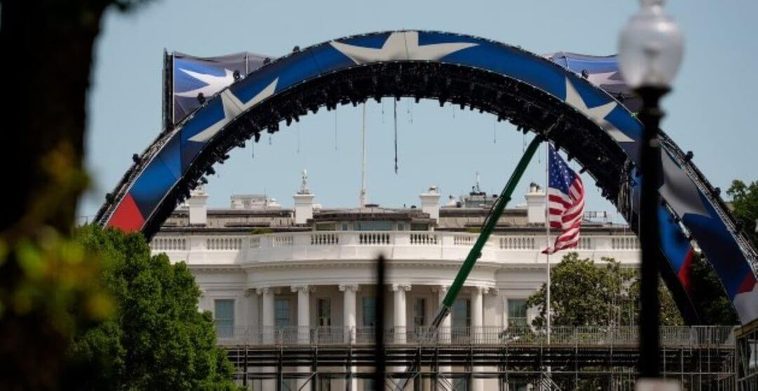
With the octagon already being prepared for installation on the South Lawn and thousands of free tickets slated for distribution, the clock is ticking. Whether the courts intervene or not, UFC Freedom 250 has already become a flashpoint in the ongoing clash over politics, culture, and the meaning of public celebration in modern America.

