
>> Continued From the Previous Page <<
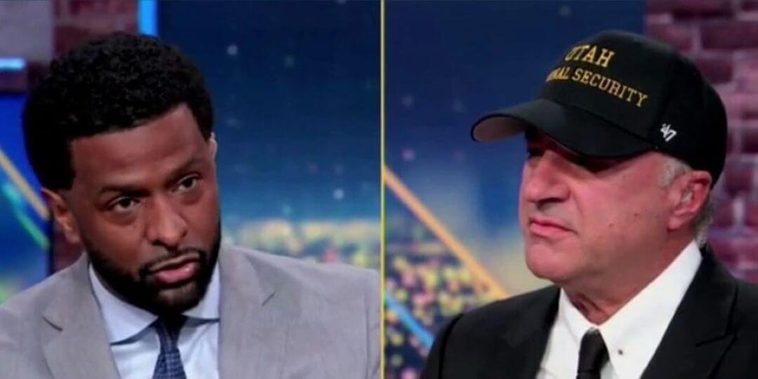
The comment, aimed at conservative legal interpretations of the Constitution and the Court’s ruling on race-based districting, instantly drew pushback from fellow panelist and businessman Kevin O’Leary, who challenged the framing and attempted to steer the discussion back toward constitutional principles and voting equality.
O’Leary pressed a straightforward question that underscored the legal divide at the heart of the debate: “The Constitution is being upheld. You have a problem with that?”

Sellers did not directly engage with the question. Instead, the exchange grew more heated, and the conversation quickly broke down into personal confrontation. At one point, Sellers lashed out at O’Leary, saying: “Don’t be a d—, just understand.”
That remark prompted immediate intervention from host Abby Phillip, who stepped in to restore order and reminded the panel of basic standards of discourse, asking for “a modicum of respect.”
From there, the segment never fully recovered its footing.
At the center of the legal dispute being discussed is the Supreme Court’s ruling that Louisiana’s congressional map violated constitutional standards by improperly sorting voters based on race. Chief Justice John Roberts and the majority concluded that the map amounted to an unlawful racial gerrymander, reinforcing the principle that district lines cannot be drawn primarily on racial classifications.
In practical terms, the Court’s decision reaffirmed that congressional representation must be grounded in equal protection principles rather than race-based assumptions. Critics of race-conscious districting argue that such practices distort representation, while supporters claim they are necessary to protect minority voting strength under the Voting Rights Act.
Sellers, however, shifted away from the legal specifics and instead drew on historical references and personal narrative, invoking civil rights-era imagery and comparing political opposition to extremist institutions of the past. His remarks did not address O’Leary’s central question about constitutional interpretation, leaving the legal argument largely unresolved on-air.
What followed was a broader exchange that highlighted the breakdown of consensus in American political media. O’Leary attempted to re-center the discussion, asking again whether the constitutional ruling itself was the issue. Sellers instead continued to frame the issue in moral and historical terms, referencing his family’s civil rights experiences and suggesting systemic parallels that critics argue went beyond the scope of the case.
The inability to reconcile those two perspectives—legal constitutional analysis versus historical and moral framing—defined the remainder of the segment.
Outside the immediate panel exchange, Democratic political figures also reacted strongly to the ruling. Hakeem Jeffries called the Supreme Court “illegitimate,” while former Democratic National Committee chair Jaime Harrison went further, comparing the Court to the era of Chief Justice Roger Taney, who presided over the infamous Dred Scott decision. Senator Bernie Sanders also weighed in, labeling the Court a “reactionary Supreme Court.”
Notably, none of those reactions engaged deeply with the Court’s constitutional reasoning on racial districting. Instead, they focused on the legitimacy of the institution itself—a pattern critics say has become increasingly common when rulings do not align with progressive legal interpretations.
Back on CNN, O’Leary ultimately closed the exchange with a final rebuttal after the insults and interruptions: “I’m not a d—. I’m pointing something out to you. The Constitution’s being upheld.”
That statement effectively distilled the divide seen throughout the segment: one side emphasizing constitutional interpretation and equal application of the law, the other framing the issue through historical grievance and broader social critique.
By the end of the broadcast, the contrast was stark. One participant repeatedly returned to constitutional text and Supreme Court reasoning. The other relied on historical analogy, personal narrative, and sharp personal attacks when challenged.
And in that clash, CNN’s panel offered a snapshot of the broader national debate—one that shows no sign of cooling down anytime soon.

