
>> Continued From the Previous Page <<
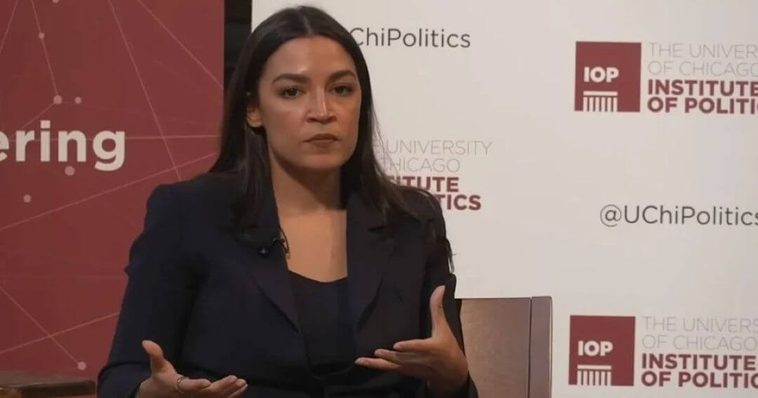
AOC’s framing reduces a complex revolution into a simple class struggle narrative, while ignoring the core political and constitutional grievances that drove the colonies toward independence from Britain.
The American Revolution was primarily rooted in escalating tensions between the colonies and the British Crown throughout the 1760s and 1770s. Colonists objected to taxation imposed by the British Parliament without colonial representation, a dispute that became the foundation of the rallying cry “no taxation without representation.”

Key legislative flashpoints such as the Stamp Act of 1765 and the Tea Act of 1773 inflamed colonial resistance, as many Americans believed the British government was overstepping its authority and violating their rights as English subjects.
Those disputes ultimately culminated in the Declaration of Independence in 1776, drafted largely by Thomas Jefferson. The document centered on political philosophy and government legitimacy, arguing that governments derive their “just powers from the consent of the governed” and accusing King George III and the British government of repeated abuses of power.
Economic frustration certainly played a role as well. British trade restrictions, taxation policies, and mercantilist rules created significant burdens on colonial merchants, farmers, and landowners. Many colonists believed Britain’s economic system favored imperial elites at the expense of local enterprise and economic freedom.
However, critics argue that interpreting the Revolution primarily as a rebellion against wealthy individuals misrepresents both its intent and its leadership.
One of the strongest rebukes came from Sen. Mike Lee, who rejected Ocasio-Cortez’s framing outright. “No, AOC, the American Revolution was NOT ‘against the billionaires of their time,” he said. “It was against a large, distant, overly intrusive government that recognized no limits over its own authority to tax, regulate, and eat out the substance of the citizens it claimed to serve.”
Sen. Ted Cruz also weighed in, sharply criticizing both the historical interpretation and what he sees as its political motivation. “If a 9th grader writes this on her history test, she gets an F,” he said. “It was literally a revolution against oppressive GOVERNMENT…the very thing @aoc wants to inflict on all of us. And the Revolution was financed by American free enterprise…the billionaires’ of that time.”
Historical records also show that many of the Founding Fathers were not poor agrarian rebels, but instead came from the colonial upper class. George Washington was one of the wealthiest landowners of his era, while Benjamin Franklin accumulated significant wealth through publishing, invention, and business ventures. Wealthy financier Robert Morris played a crucial role in funding the Revolutionary War effort itself.
Rather than rejecting wealth outright, many of the Founders focused on limiting centralized authority, protecting private property, and designing a system of government restrained by checks and balances. Those principles were later embedded into the U.S. Constitution, which established federalism and safeguarded individual rights against government overreach.
At the same time, historians acknowledge that early Americans were wary of concentrated power in all forms—whether political, aristocratic, or economic. That suspicion continues to influence American political debate more than two centuries later, as leaders across the spectrum invoke the Founding era to justify competing visions of government and economic policy.
Ocasio-Cortez, for her part, has consistently pushed for higher taxes on wealthy Americans, expanded labor protections, and broader federal programs aimed at reducing economic inequality. Her latest comments fit squarely within that broader political narrative.
Still, critics argue that rewriting the Revolution as a struggle against “billionaires” risks flattening one of the most important and philosophically grounded movements in modern history into a simplified talking point—one that may say more about today’s political battles than the founding of the United States itself.

