
>> Continued From the Previous Page <
According to the Chinese report, American business leaders expressed strong interest in expanding their footprint inside China’s market. “The U.S. entrepreneurs said that they attach great importance to the Chinese market, and hope to deepen their business operations in China and strengthen cooperation with China,” the newspaper said.
The White House also echoed the tone of economic engagement in a statement posted to X, suggesting both sides were actively exploring expanded cooperation. “The two sides discussed ways to enhance economic cooperation between countries, including expanding market access for American businesses into China and increasing Chinese investment,” the White House said in a statement on X.

The messaging from Beijing did not go unnoticed by analysts watching the evolving relationship between the world’s two largest economies. George Chen, partner and co-chair of digital practice at The Asia Group, said Xi’s remarks carried strategic intent beyond simple diplomacy. He explained, “Xi’s comments are ‘a strong statement to world companies to continue to invest in China,’ said George Chen, partner and co-chair of digital practice at The Asia Group.”
Chen added further context, saying, “I think the statement Xi made about opening up is not just for propaganda. China does need to remain attractive for foreign investments,” Chen added.
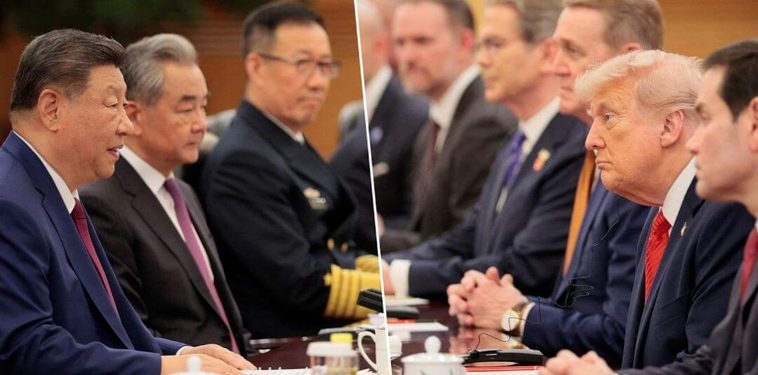
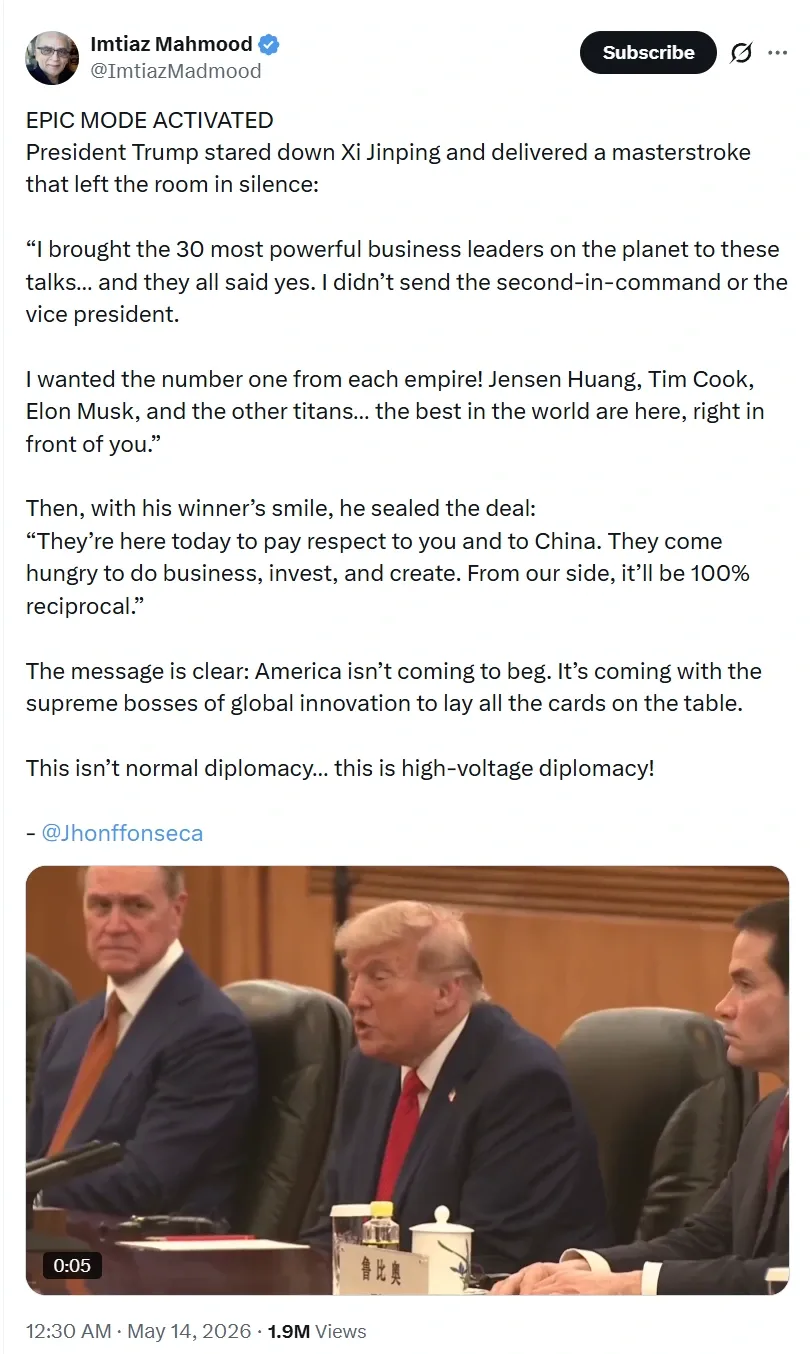
During brief on-camera remarks, Trump used the moment to highlight the presence of major U.S. business leaders and frame the meeting as a potential turning point in economic relations. He stated: “I brought the 30 most powerful business leaders on the planet to these talks… and they all said yes. I didn’t send the second-in-command or the vice president,” Trump said.
He continued by emphasizing the stature of the executives present: “I wanted the number one from each empire! Jensen Huang, Tim Cook, Elon Musk, and the other titans… the best in the world are here, right in front of you,” Trump added.
Trump further stressed cooperation and mutual benefit, saying: “They’re here today to pay respect to you and to China. They come hungry to do business, invest, and create. From our side, it’ll be 100% reciprocal,” the president continued.
Beyond economic issues, the discussions also reportedly touched on global security concerns, including Iran. Both leaders reportedly emphasized that Tehran must not obtain a nuclear weapon and must ensure the Strait of Hormuz remains open to international shipping.
On Fox News’ Fox & Friends, co-host Brian Kilmeade analyzed the broader implications of the Trump-Xi meeting, suggesting ripple effects for global alliances—particularly involving Russia and President Vladimir Putin.
Kilmeade remarked, “It looks like he’s [Trump] saying, ‘We’re the two leaders, let’s find a way to get along.’ You know who’s having a really bad day and week or two weeks? Vladimir Putin,” Kilmeade said.
He continued with a broader geopolitical assessment: “I mean, not only is he beginning to lose the war in Ukraine, he’s seeing that special relationship supposed to realign the world go up in flames,” he continued.
Further expanding on the shifting alliances, Kilmeade added: “Because at the very least, if we’re just to look at the words of the leaders, they’re looking to work together,” he added.
He concluded his analysis by noting strategic pressure on Moscow: “Vladimir Putin’s hope was to get China on their side and work together as a junior partner and isolate us,” he continued. “And I think that President Xi is saying, ‘well, that’s not gonna happen.’”
The two-day visit marks Trump’s first trip to China since 2017, underscoring how much the global landscape has shifted in recent years.
The talks come at a critical moment, with tensions continuing over trade policy, artificial intelligence competition, Taiwan, and the wider fallout from conflicts involving Iran and global energy routes. As both sides signal potential cooperation while still navigating deep strategic rivalries, the world is watching closely to see whether this renewed engagement signals lasting stability—or just a temporary thaw in an increasingly complex relationship.

