
>> Continued From the Previous Page <<
But the political significance may stretch far beyond a single district.
Legal analysts note that the Supreme Court’s willingness to halt the lower court ruling could signal the justices’ broader skepticism toward race-based districting — a key component of enforcement under the Voting Rights Act. If the court ultimately moves to strike down or limit those provisions, it could reshape congressional maps across the country.

Such a decision could potentially eliminate many majority-minority districts, which Democrats have historically relied on to secure representation in certain regions. In practical terms, that could translate into the loss of numerous Democratic seats in the House of Representatives.
Even liberal outlets acknowledged the significance of the ruling. The The New York Times described the decision as a “Republican win,” though the deeper concerns emerged as analysts examined what the ruling might foreshadow for future cases.
One case drawing particular attention is Louisiana v. Callais, which is currently before the Supreme Court. At the center of that dispute is whether the state of Louisiana violated constitutional principles when it created a second majority-minority congressional district.
If the court concludes that such districts are unconstitutional, the ramifications could extend nationwide. Observers warn the ruling could “scramble the country’s congressional maps,” dramatically altering the political balance in Washington.
Progressive media outlets are already sounding the alarm. Writers at Mother Jones argued that Alito’s reasoning could undermine decades of civil rights law. The publication warned that the justice’s argument essentially suggests that policies designed to address historic discrimination could themselves be considered discriminatory.
However, critics of race-based districting argue the issue is about equal treatment under the law — not politics.
As the 2026 election cycle approaches, the stakes are extremely high. Current Senate and gubernatorial battleground maps are widely viewed as favorable to Republicans, meaning Democrats are counting heavily on regaining control of the House of Representatives if they hope to block the agenda of President Donald Trump.
If the Supreme Court ultimately limits race-based redistricting under the Voting Rights Act, that strategy could collapse.
The Democratic Party is also facing internal challenges. Despite years of speculation about future leadership, no single figure has emerged as a clear frontrunner for the 2028 presidential race against Vice President J.D. Vance.
Even media analysts have taken note. Harry Enten, chief data analyst at CNN, recently described the Democratic presidential field as chaotic.
“This is just a downright clown car at this point on the Democratic side,” he said.
During oral arguments in Louisiana v. Callais last year, Justice Brett Kavanaugh also raised questions about how long race-based remedies should remain in place under federal law.
“The issue, as you know, is that this court’s cases in a variety of contexts have said that race-based remedies are permissible for a period of time,” he said. “Sometimes for a long period of time, decades in some cases. But that they should not be indefinite and should have an end point.”
Media figures have acknowledged the possible implications as well. Dana Bash of CNN warned, “This ruling has the potential to undermine, if not completely overturn, a core provision of the Voting Rights Act, intended to ensure black voters have adequate representation.”
Meanwhile, CNN Washington Bureau Chief David Chalian suggested the outcome could shift the political landscape for years.
If the court sides with Republican arguments, he said, it could create a “permanent advantage for Republicans in building an enduring majority.”
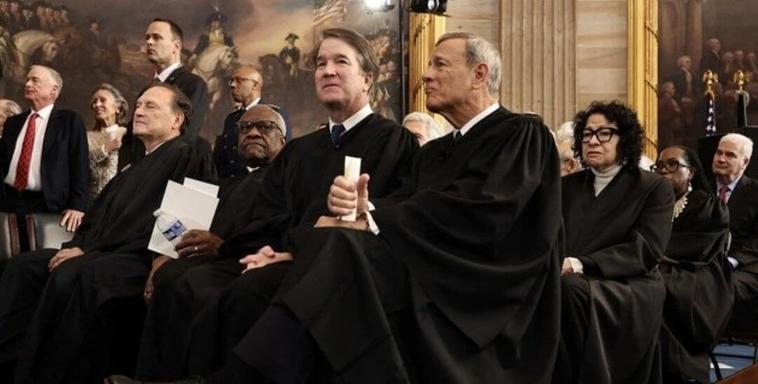
Even Chief Justice John Roberts has previously expressed skepticism about race-based policies, famously stating: “The way to stop discrimination based on race is to stop discriminating based on race.”
That philosophy appears to be increasingly influential in the court’s approach.
Supporters of reform point out that the Voting Rights Act was enacted in 1965 — more than six decades ago — to address a very different political landscape. They argue the law’s race-based provisions were intended as temporary measures, not permanent fixtures.
Whether the Supreme Court agrees remains to be seen.
But one thing is certain: as the 2026 midterm elections approach, the court’s eventual decision could dramatically reshape the political battlefield in Washington — and potentially redefine the rules governing congressional representation for decades to come.

