
>> Continued From the Previous Page <<
Supporters of Gottheimer’s measure argue that the situation on the ground demands a more nuanced response than the blanket restrictions proposed in other legislation. According to the New Jersey Democrat, Iranian forces have already intensified attacks across the region.
“Iran is actively firing drones and ballistic missiles at U.S. troops, our embassies, allies, and is targeting civilians across the region,” Gottheimer wrote on X. “This new Democratic War Powers Resolution will uphold Congress’s constitutional authority — while also ensuring the U.S. can defend our troops, embassies, and allies from Iranian aggression. We must protect our troops and allies.”

Several Democrats have already joined Gottheimer in backing the new resolution. Those lawmakers include Jimmy Panetta of California, Jared Golden of Maine, Henry Cuellar of Texas, Jim Costa of California, and Greg Landsman of Ohio. Their support underscores a clear fracture within the Democratic caucus over how aggressively Congress should move to restrain the administration.
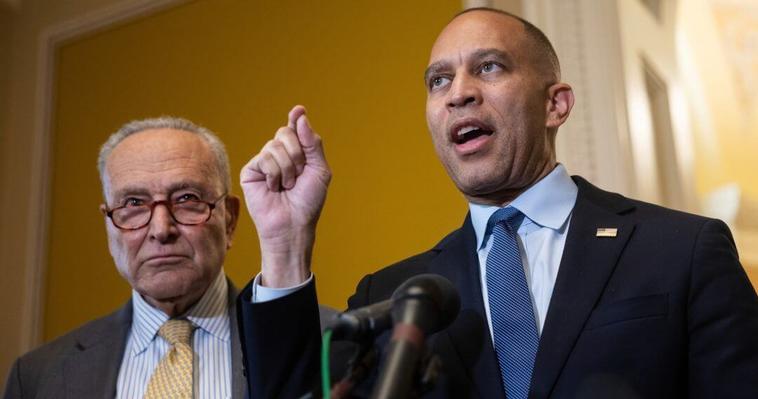
Meanwhile, Jeffries and Democratic leadership are throwing their weight behind a separate resolution crafted by an unusual bipartisan pair: Republican Rep. Thomas Massie and Democratic Rep. Ro Khanna. Their legislation would require the president to halt U.S. military operations against Iran unless Congress explicitly authorizes continued action.
Gottheimer’s proposal takes a more measured approach. While allowing the current operation to continue for a short period, it places clear limits on escalation. The resolution explicitly prohibits the deployment of American ground forces inside Iran without congressional approval, though it does permit limited exceptions for “search and rescue missions.”
The bill would also compel the administration to provide detailed briefings to lawmakers outlining the “goals, objectives, and timeline of major military action.” Supporters say that requirement ensures transparency while still allowing the commander-in-chief to respond to immediate threats.
Another key provision, according to Gottheimer, affirms that the United States retains the “right to defend itself, our armed forces, embassies, and allies from Iranian attacks.” Backers say that language addresses concerns that some war powers measures could inadvertently weaken America’s defensive posture in the Middle East.
Rep. Landsman was among those raising red flags about the Massie-Khanna resolution. He argued that its language could force the United States to withdraw defensive systems currently protecting allies and American personnel across the region.
“I don’t support the resolution, which would require us to completely abandon our allies. It calls for the immediate removal of defensive weapons in the region,” Landsman told the Washington Examiner last week. “The Administration returned to the practice of notifying Congress of a strike with Rubio briefing the Gang of 8 last week. The strikes are an attempt to prevent further war, not to start one.”
Despite the objections raised by some members of his own party, Jeffries has continued pushing forward with the Massie-Khanna measure and has signaled that a vote could occur soon.
During a press conference Tuesday, Jeffries predicted that Democrats would overwhelmingly rally behind that proposal, telling reporters that “there is going to be very strong Democratic support” for the legislation. When asked about Gottheimer’s alternative plan, however, the minority leader acknowledged he had not yet reviewed it.
Jeffries has also drawn criticism for recent remarks about the consequences of military action against Iran. His comments sparked backlash after he suggested the operation could lead to significant American casualties.
“Article 1 of the Constitution explicitly provides Congress with the authority to declare war, period, full stop. And the framers of the Constitution made that decision because they were concerned about kings throughout time getting their people into unnecessary wars, impoverishing them or imperiling their very well-being by sending them off to a foreign conflict. And that’s why the power was given explicitly to the House and to the Senate,” Jeffries said during an interview on CNN.
“And Donald Trump chose intentionally not to come before Congress, which is why we’re going to force this vote on a war powers resolution and make sure that we do everything we can to constrain him at this point in time,” the New York Democrat added.
With Democrats now split between competing resolutions, the debate over America’s response to Iran is quickly becoming one of the most contentious fights on Capitol Hill — and it may ultimately determine how much freedom the president has to continue the military campaign in the weeks ahead.


why didn’t democrats cry out and do this during the obama administration?