
>> Continued From the Previous Page <<
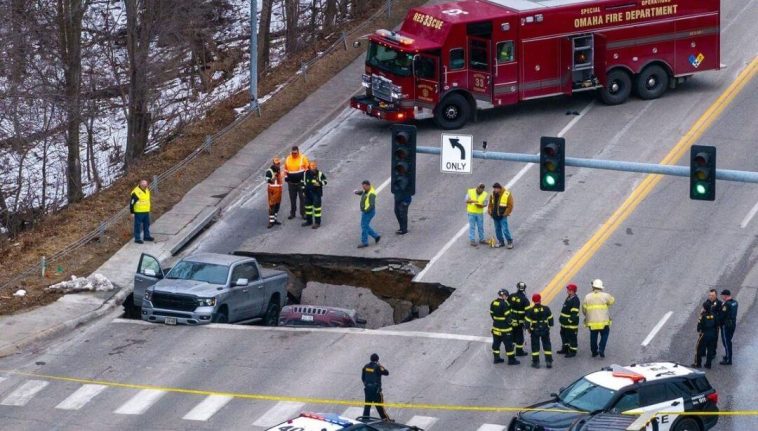
Bystanders rushed toward the gaping hole before first responders even arrived. Miraculously, both drivers were able to climb out without serious injury.
Heavy-duty tow trucks later worked for hours to extract the vehicles from the crater as crews tore up damaged concrete well into the night. Pacific Street between 66th and 69th streets was quickly shut down. Officials say it will remain closed indefinitely as engineers assess the damage.

What Caused the Collapse?
City officials pointed to a failing water main beneath the roadway.
Omaha City Engineer Austin Rowser explained that a pressurized line had been slowly eroding soil under the street, likely for months. The soil was being scoured away and funneled into the storm sewer system, hollowing out the ground from below.
“Ultimately it comes down to erosion,” Rowser said, “because all pavement, as you know, it’s not built to stand on its own. It has to have the support from the soil underneath it.”
By the time two vehicles were sitting above the weakened patch of asphalt, it was too late. The added weight was enough to trigger the collapse.
When crews opened the area, they found it mostly dry. This was not a dramatic, sudden pipe explosion. It was a slow-moving failure, quietly unfolding underground while traffic flowed overhead day after day.
The Bigger Picture: America’s Aging Infrastructure
The Omaha sinkhole is not just a freak accident. It is a warning sign.
The American Society of Civil Engineers recently gave the nation’s drinking water systems a C- in its 2025 infrastructure report card. That grade has not improved in four years.
Despite massive federal spending announcements, the overall condition of water infrastructure remains stagnant. The Environmental Protection Agency now estimates the country needs roughly $625 billion over the next two decades to repair and modernize its water systems. That figure has grown by more than $150 billion since 2018.
Meanwhile, the pace of replacing aging systems has slowed. Renewal rates for major water projects have dipped, while failures per mile of pipe have climbed.
In simple terms, pipes are breaking faster than they are being replaced.
Many municipalities lack full asset management plans, meaning they do not have a clear picture of which lines are at risk. In Omaha’s case, there were reportedly no prior leak reports, no obvious pressure data anomalies, and no clear warning signs before the ground gave way.
That reality is not unique to Nebraska.
A Viral Moment That Sparked National Frustration
Social media lit up after the footage spread online. Reactions ranged from disbelief to anger.
One widely shared comment captured the mood: “Send more money to other countries as American infrastructure degrades.”
That frustration reflects a broader national debate about how federal infrastructure dollars are allocated and how quickly projects move from announcement to completion.
Transportation Secretary Pete Buttigieg has previously acknowledged that large infrastructure projects can take years to complete. But for Americans watching a street swallow two vehicles in real time, patience is wearing thin.
The Omaha collapse has become more than just a local incident. It has turned into a visual reminder of the fragile systems beneath American roads.
A Street That Could Be Anywhere
Pacific Street will remain closed while geotechnical crews map the underground void and determine the full extent of the damage. Two vehicles are likely totaled. Repairs could take weeks.
But the larger question lingers: how many other streets across America are resting on aging pipes and eroding soil?
Every city with decades-old infrastructure has vulnerable stretches of road. Most just have not failed yet.
The Omaha sinkhole was caught on camera. That is why the nation saw it. The next one might not be so visible until it is too late.
For now, two drivers walked away unhurt. But the images of that road collapsing without warning have already etched themselves into the national conversation about infrastructure, spending, and accountability.
And millions of Americans are left wondering what lies beneath the pavement they drive over every single day.

