
>> Continued From the Previous Page <<
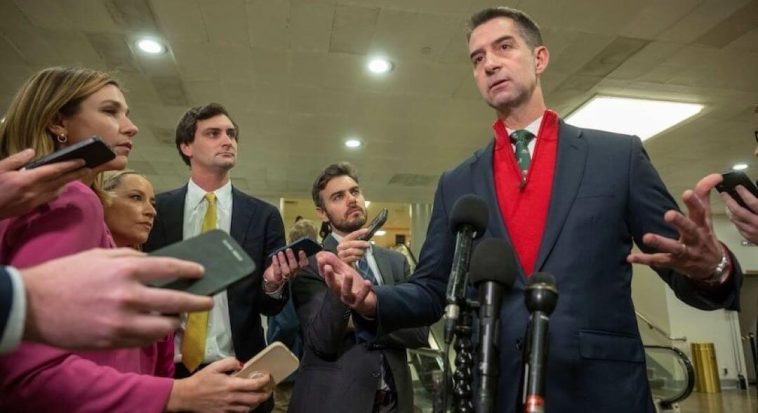
Schmitt immediately challenged the framing.
“Fishing boats? What is a fishing boat? The drug runners?” Schmitt responded.

When the reporter confirmed the reference, Schmitt flatly rejected the premise.
“Those aren’t fishing boats,” Schmitt replied.
As the reporter attempted to continue, Schmitt cut in again, repeating for emphasis, “Those aren’t fishing boats.”
The Missouri senator then shifted the discussion from media narratives to constitutional authority and national security. He argued that the president has clear power to act decisively against organizations that are actively poisoning Americans.
“Okay. Well, let’s talk about Article II authority. The President, the Commander in Chief, has identified and designated terrorist organizations cartels who run drugs that kill 100,000 Americans a year,” Schmitt said.
“There’s no legal question that he has the authority to blow those boats out of the water, and they will continue.”
Schmitt also drew a sharp legal distinction between military action against cartel assets and the enforcement of economic sanctions, which critics have attempted to lump together.
“This, however these were economic sanctions by the President, as delegated by Congress,” he explained. “Those were enforced by civil authorities with the aid of the U.S. Navy. We’re talking about two very different things.”
The exchange ended with Schmitt delivering a blunt statement that resonated with many Americans who have watched their communities ravaged by fentanyl overdoses and cartel violence.
“But if you’re asking me if I have sympathy for narco-terrorists killing Americans, whose boats are carrying the drugs that kill Americans, I don’t,” Schmitt said. “I have sympathy for my neighbors in Missouri who’ve been poisoned, who die.”
He then took direct aim at Democrats who, in his view, prioritize political theater over public safety.
“We finally have a President who cares about them more than Democrats care about going down to El Salvador to drink margaritas with terrorists. That’s how I feel about it.”
U.S. officials have repeatedly stated that the vessels targeted in recent operations are not civilian fishing boats at all. According to law enforcement and defense sources, these boats are specialized smuggling platforms built for speed, range, and stealth. They are operated by cartel personnel and used exclusively to move massive quantities of narcotics toward the United States.
Authorities say these maritime routes are a major pipeline for fentanyl and other deadly drugs that have killed tens of thousands of Americans each year. Allowing those vessels to operate unchallenged, they argue, only strengthens the cartels and prolongs the crisis.
The Trump administration has taken a hard line, insisting that cartel assets should be treated as hostile threats rather than misunderstood civilian craft. Officials maintain that disrupting drug routes at sea is a critical component of stopping fentanyl before it reaches American streets.
Schmitt’s fiery exchange highlighted a growing divide in Washington. On one side are lawmakers demanding aggressive action against transnational cartels. On the other are media voices and Democrats who appear more concerned with semantics than with the body count left behind by narcotics trafficking.
For families who have lost loved ones to fentanyl, the issue is not academic. As Schmitt made clear, the debate is not about “fishing boats.” It is about whether the United States is willing to confront narco-terrorists with the seriousness the crisis demands.

