

>> Continued From the Previous Page <<
Greg Waller, a service coordination hydrologist with the NWS West Gulf River Forecast Center in Fort Worth, made that crystal clear. “The NWS forecasting offices were operating normally at the time of the disaster,” he told Politico.
“We had adequate staffing. We had adequate technology,” Waller confirmed. “This was us doing our job to the best of our abilities.”

In other words, the people blaming Trump don’t have the facts on their side.
Tom Fahy, legislative director for the National Weather Service Employees Organization, backed up that assessment. Speaking to the Texas Tribune, he said staffing was “adequate to issue timely forecasts and warnings before and during the emergency.”
Far from dropping the ball, NWS was issuing alerts well before the worst of the flooding began. According to the Associated Press, there were “a series of flash flood warnings in the early hours Friday before issuing flash flood emergencies — a rare alert notifying of imminent danger,” beginning Thursday afternoon. The warnings grew more dire as time went on, culminating in a chilling 4:03 a.m. alert that warned of “the potential of catastrophic damage and a severe threat to human life.”
Those alerts were echoed and promoted by the U.S. Department of Homeland Security across social media, directly refuting the narrative that the agency was underperforming due to cuts.
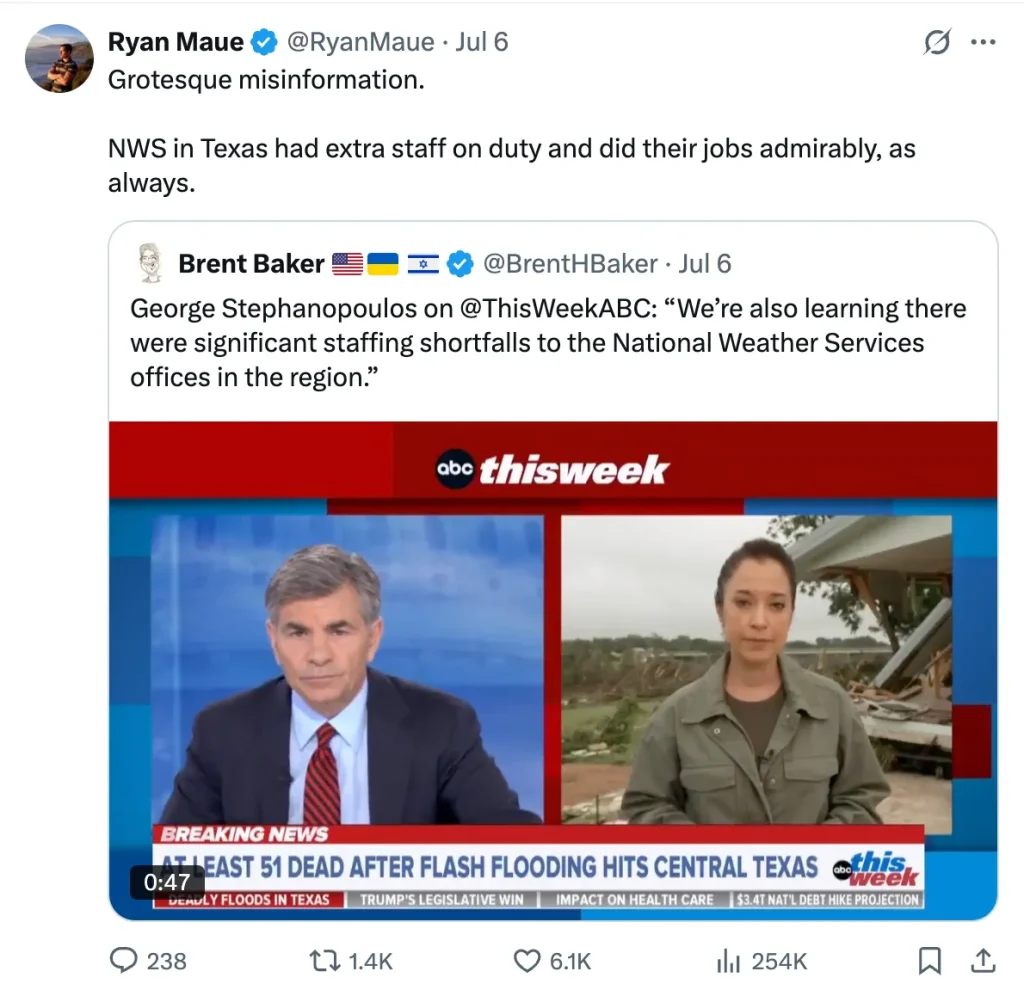
Meteorologist Ryan Maue, who holds a PhD in meteorology from Florida State University, was one of many experts to slam the media’s reporting. He called Stephanopoulos’s claims “[g]rotesque misinformation.”
“NWS in Texas had extra staff on duty and did their jobs admirably, as always,” Maue tweeted on Sunday.
Even some who have been critical of Trump’s past weather-related policies admitted that this time, the attacks are baseless. Matt Lanza, a journalist and meteorologist who’s previously scrutinized Trump’s approach to NOAA and NWS funding, conceded the truth.
“In this particular case, we have seen absolutely nothing to suggest that current staffing or budget issues within NOAA and the NWS played any role at all in this event. Anyone using this event to claim that is being dishonest,” Lanza wrote in The Eyewall.
He went even further, praising the use of weather balloon data in helping provide early warnings. “If you want to go that route, use this event as a symbol of the value NOAA and NWS bring to society,” he added.
So if staffing or funding wasn’t to blame, what was?
Local officials are pointing to an important—yet overlooked—decision made years ago. According to Kerr County’s top official Rob Kelly, residents rejected an emergency broadcast system several years ago due to cost concerns.
“The public reeled at the cost,” Kelly told the AP, explaining that he had proposed a nighttime warning system similar to tornado sirens. Had that system been in place, lives might have been saved.
In the end, the real story is this: weather officials did their jobs with professionalism and precision. The tragedy was not the result of Washington politics—it was a natural disaster made worse by local policy decisions and the unpredictable fury of nature itself.
But as usual, instead of facts, Democrats and their media allies rushed to exploit the crisis for political gain. Thankfully, experts on the ground have come forward to expose the truth.

