

>> Continued From the Previous Page <<
“It has become untenable and counterproductive to the best interests of my constituents for me to remain a Democrat,” she added.
Webb’s political career began back in 1998, when she was first elected to the Kentucky State House after defeating Republican Ramona Gee. Since then, she has been a consistent presence in Kentucky politics, known for her pragmatic, no-nonsense approach and strong advocacy for working-class families and the coal industry.
Her exit from the Democratic Party comes at a time when Kentucky Democrats have already been struggling to hold influence in rural regions. Once bolstered by labor unions and coal country ties, the party’s identity crisis has opened the floodgates for a red wave across the state.

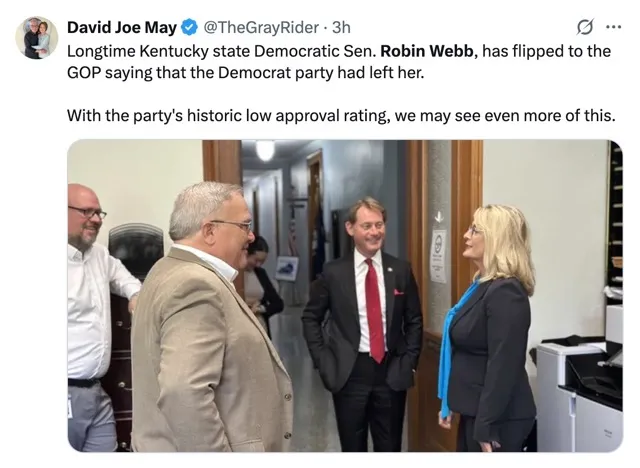
Kentucky Republican leaders were quick to embrace Webb’s decision, with GOP Chairman Robert Benvenuti praising her history of common-sense policymaking and commitment to her district.
“Like countless other Kentuckians, [Webb] has recognized that the policies and objectives of today’s Democratic Party are simply not what they once were, and do not align with the vast majority of Kentuckians,” Benvenuti said.
“I always respected that [Webb] approached issues in a very thoughtful and commonsense manner, and that she never failed to keenly focus on what was best for her constituents,” he added. “It is my pleasure to welcome Sen. Robin Webb to the Republican Party.”
Despite the praise she received from her new political home, Webb’s departure didn’t sit well with her former party. Kentucky Democratic Party Chair Colmon Elridge lashed out, accusing her of aligning with Republicans who he claims are attacking working-class Kentuckians.
“Senator Webb has chosen to join a political party that is currently working around the clock to take health care away from over a million Kentuckians, wipe out our rural hospitals, take food off the table of Kentucky families and take resources away from our public schools,” Elridge said. “If those are her priorities, then we agree: she isn’t a Democrat.”
But Webb’s message was clear—and echoed a phrase that has become a rallying cry for disillusioned moderates and centrists walking away from the modern Democratic Party:
“While it’s cliché, it’s true: I didn’t leave the party — the party left me,” she stated.
Her switch is more than a symbolic move; it’s a stark warning sign for Democrats across the country. As their platform continues to drift toward the extreme left, they risk losing more than just voters—they’re losing their own leaders. For Republicans, Webb’s move reinforces what many see as a growing shift of momentum and values toward the conservative movement.
Kentucky just became another battleground in that realignment—and Democrats just lost a key voice from coal country.

