
>> Continued From the Previous Page <<
The subsequent 65-mile Bataan Death March was a brutal ordeal. Nearly 6,000 of the 78,000 captives perished en route due to physical exhaustion, Japanese brutality, and denial of food and water.
MacArthur, ordered by President Franklin Roosevelt to escape the besieged Philippines, famously vowed, “I shall return.” This promise became a symbol of hope for both the Filipino people and the American troops left behind. Nearly three years later, MacArthur fulfilled his pledge, beginning with the October 1944 landings on Leyte Island and pushing onward to liberate the archipelago.

By early 1945, U.S. forces advanced toward Manila, but danger loomed for the remaining POWs still in Japanese custody. As the front lines closed in, it was feared the captors would execute their prisoners. Among these camps was Cabanatuan, where over 500 American POWs endured unimaginable suffering.
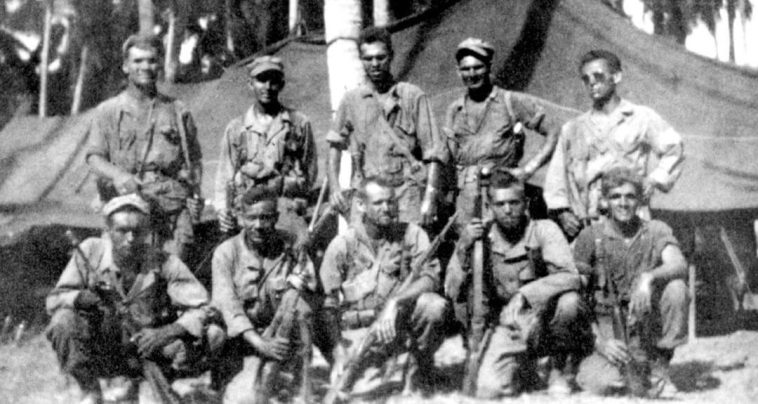
General Walter Krueger of the Sixth Army authorized a high-stakes mission to save them. Charlie Company of the 6th Ranger Battalion, strengthened to 120 men, was chosen to infiltrate 30 miles behind enemy lines. They were joined by 200 Filipino guerrillas under Captain Juan Pajota. Their adversaries included 250 Japanese guards at the camp and nearly 10,000 enemy troops stationed nearby.
Lt. Col. Henry Mucci, commanding the rescue force, gave his soldiers a sobering pep talk. “Swear to God that you’ll die if need be rather than let any harm come to our POWs!” he reportedly urged. Not one soldier opted out of the mission.
The daring operation began on the night of January 30, 1945. A P-61 Black Widow aircraft created a diversion by flying low over the camp while Rangers advanced undetected. At precisely 7:44 p.m., gunfire erupted as the rescue team neutralized Japanese guards and stormed the gates.
For the POWs, the chaos was initially terrifying, with many fearing they were being executed. Instead, they were swiftly guided to safety. Meanwhile, Pajota’s guerrillas valiantly held off nearby Japanese reinforcements, destroying a bridge to delay enemy tanks and repelling infantry assaults with machine-gun fire.
Under the cover of night, the freed prisoners marched to safety. For some, it was a poignant reversal of their harrowing ordeal in the Bataan Death March. “We wept openly, and we wept without shame,” recalled former POW Abie Abraham upon seeing the American flag at friendly lines.
General MacArthur visited the survivors days later, moved to tears by their suffering. “I’m too late,” he reportedly apologized repeatedly.
KICK OUT The Cold and Say Hello to The Handyheater! Warming Any Spot INSTANTLY!
The rescue, which saved 516 POWs at the cost of two Ranger lives, is celebrated as a model operation of precision and bravery. “It was a brilliant operation done with the minimum of casualties and the maximum of result,” said military historian Dr. Conrad Crane.
For the Rangers, the mission was deeply meaningful. Cpt. Robert Prince, reflecting on the raid, said, “I’ll be grateful for the rest of my life that I had a chance to do something in this war that was not destructive.”
This incredible story remains a testament to courage, sacrifice, and the unwavering determination to bring freedom to those in need.

