
>> Continued From the Previous Page <<
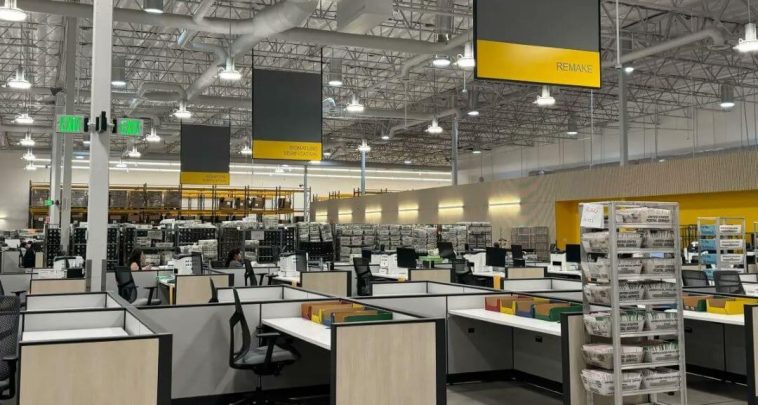
Inside the facility, rows of empty desks reportedly stretched across portions of the building. Several areas containing vacant chairs and unused workstations stood out to visitors. In one section where ballots rejected by scanners require manual review, containers filled with ballots reportedly sat ready for examination. Yet no employees were seen working nearby.
Another area responsible for opening envelopes and preparing ballots for counting reportedly contained only a fraction of the workers the space was designed to accommodate.

The images have fueled criticism from those who argue that California’s election system remains unnecessarily slow despite receiving enormous amounts of public funding.
One of the loudest critics has been gubernatorial candidate Steve Hilton, who blasted the state’s handling of election reporting and called for immediate action.
“California is the laughing stock of the nation when it comes to election reporting. We are the fourth-largest economy in the world, home to Silicon Valley and some of the most advanced technology on earth, yet government bureaucrats need a month to count fewer than 10 million ballots,” Hilton said.
Hilton proposed what he called an Emergency Election Count Accelerator Corps, a plan that would deploy additional state personnel and resources to counties facing significant ballot-counting delays. According to Hilton, the goal would be to accelerate processing while fully maintaining election laws, security safeguards, and existing counting procedures.
The controversy has drawn even more attention because of the department’s enormous budget.
Los Angeles County allocates nearly $336 million annually to its Registrar-Recorder/County Clerk operation. County budget documents also show the department has more than 1,100 authorized positions.
At the center of the operation is Registrar-Recorder/County Clerk Dean Logan, who oversees election administration for the county and reportedly receives annual compensation exceeding $448,000.
Critics argue that with that level of funding, staffing, and infrastructure, voters should not be waiting weeks for election outcomes.
President Donald Trump weighed in on the controversy as well, accusing Democrats of benefiting from the lengthy counting process.
“The Dumocrats are at it again! They are trying to STEAL THE GOVERNOR OF CALIFORNIA PRIMARY, AND THE MAYOR OF LOS ANGELES, PRIMARY, AWAY FROM TWO GREAT REPUBLICAN CANDIDATES. Here we go with the very late and massive numbers of MAIL IN BALLOTS,” he posted on Truth Social.
California officials quickly pushed back.
“There is a lot of misinformation floating around about California’s election — including from the President,” the post read, while sharing an explainer video from CNN on the counting efforts, Gavin Newsom’s office posted on X in a response.
“And yes, for the record: we wish the votes were counted faster, too,” the post concluded.
The exchange has only intensified the national spotlight on California’s election system.
Los Angeles County alone maintains more than 5.8 million registered voters, making it larger than the populations of many entire states. Yet while California continues working through its backlog, numerous states that also held elections have already reported overwhelming majorities of their votes counted.
New Jersey has nearly completed its tally, while states such as New Mexico and Montana are approaching completion rates close to 98 percent.
Questions remain unanswered.
When reporters asked election officials why so many workstations appeared empty despite the mountain of ballots still awaiting processing, they received little clarification.
One employee cautioned visitors not to be “fooled by what you see.”
When asked to explain further, the employee reportedly declined to elaborate and walked away.
For now, voters remain in limbo.
Another ballot-count update is expected soon, but with more than 700,000 ballots still outstanding, election observers say the final outcome of several key races may remain uncertain for weeks. As scrutiny grows, taxpayers and voters alike are demanding answers about why one of America’s most expensive election operations continues moving at such a slow pace.


GAVIN NEWSOM IS A LYING SCUMBAG, AND. CHEATER!! HE’S ALREADY SAID HE WILL NOT ALLOW THIS ELECTION TO TAKE AWAY THE DEMOCRAT’S POWER IN CALIFORNIA!! WHAT, EXACTLY, IS “BREAK THE GLASS” EXECUTIVE ORDER!?? CALIFORNIA NEEDS VOTER I.D. MORE THAN EVER!! PRESIDENT TRUMP!! HELP US!!!