
>> Continued From the Previous Page <<
Just days later, Trump doubled down publicly, making clear that U.S. intelligence had mapped Venezuela’s drug infrastructure in detail.
“We’re gonna start that same process on land because we know every route. We know every house. We know where they live,” Trump announced at a December 6 event.
Those statements were not political theater.

On Christmas Eve, Maduro reportedly learned that Trump was serious. According to CNN, a CIA-operated drone strike hit a remote dock facility along Venezuela’s coastline, a location U.S. intelligence identified as a staging point for the notorious Tren de Aragua gang. The dock was allegedly used to store narcotics and load shipments bound for international markets.
The strike caused no casualties, as the site was reportedly unoccupied at the time. But the damage was decisive. The dock infrastructure was destroyed, along with several boats used for trafficking operations. It marked the first confirmed U.S. strike on Venezuelan territory since Trump launched his renewed pressure campaign.
Trump addressed the operation days later during a radio interview, offering confirmation in his own unmistakable style.

“They have a big plant or a big facility where the ships come from,” Trump told radio host John Catsimatidis. “Two nights ago, we knocked that out. We hit them very hard.”
Pressed again by reporters, Trump refused to retreat or soften his position.
“There was a major explosion in the dock area where they load the boats up with drugs,” Trump stated. “They load the boats up with drugs. So we hit all the boats, and now we hit the area. It’s the implementation area, that’s where they implement, and that is no longer around.”
Behind the scenes, Trump had already rewritten the rulebook.
Earlier this year, the president expanded CIA authority across Latin America, authorizing covert lethal action against designated drug cartels and hostile regimes cooperating with them. The directive marked a sharp departure from previous policy, restoring the agency’s operational role in targeted strikes.
Under earlier administrations, U.S. forces were largely restricted to interdicting trafficking vessels in international waters. Trump’s order removed those constraints, allowing action directly against infrastructure on foreign soil when national security threats were identified.
According to intelligence sources, the Christmas Eve operation involved an MQ-9 Reaper drone equipped with Hellfire missiles, the same platforms currently stationed in Puerto Rico as part of the Caribbean security buildup.
Defense Secretary Pete Hegseth framed the mission in stark terms during a recent speech.
“These narcoterrorists are the al-Qaeda of our hemisphere,” Hegseth declared. “And we are hunting them with the same sophistication and precision that we hunted al-Qaeda.”
The legal groundwork for the strike had already been laid. In February, Trump formally designated Tren de Aragua as a Foreign Terrorist Organization, granting the administration expanded authority to target its leadership and assets. The designation also opened the door for intelligence-led operations under Title 50 authorities.
The administration’s broader objective has been openly acknowledged. Trump’s Chief of Staff Susie Wiles revealed in a Vanity Fair interview that the pressure campaign is designed to force Maduro to “cry uncle” and relinquish power.
Maduro, for his part, has responded with predictable outrage. Venezuelan officials condemned the strike as a violation of international law, while Maduro warned of “regime change” tactics reminiscent of past U.S. interventions.
But Trump has shown little concern for such complaints.
With a $50 million reward now offered for information leading to Maduro’s capture and continued operations targeting cartel infrastructure, the message from Washington is unmistakable.
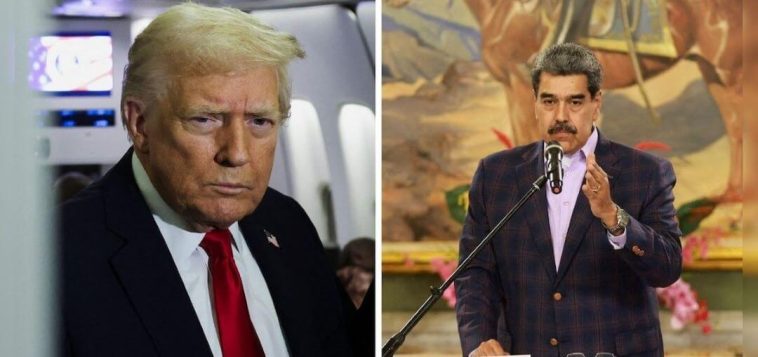
Trump warned Maduro that land strikes were coming.
Now Maduro knows Trump keeps his word.

