
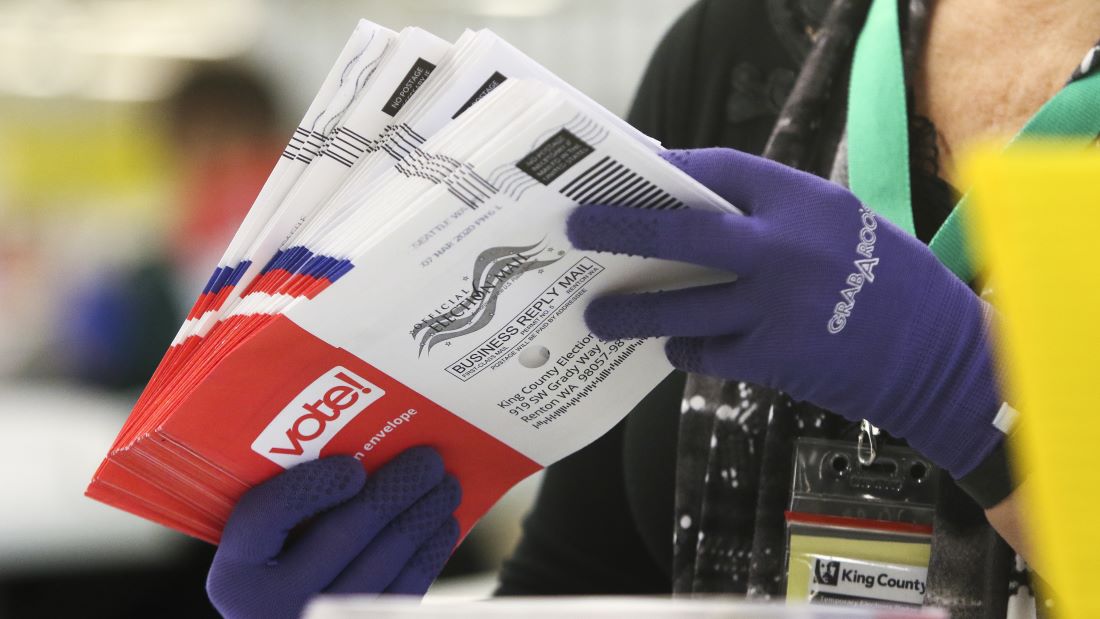
According to a recent study looking at the possible effects of forged mail-in ballots in the 2020 election, there would “almost certainly” have been a different result if mail-in voting had not been greatly expanded.
The Heartland Institute study attempted to estimate the likely influence that phony mail-in votes for President Donald Trump and then-candidate Joe Biden would have had on the final results of the 2020 election.
Don’t miss this! Carry faith with you everywhere with the Exclusive National Prayer Coin!

Based on information gathered from a Heartland/Rasmussen survey conducted in December, the study concluded that approximately one in five mail-in voters acknowledged engaging in possibly fraudulent behavior during the presidential election.
Subsequent data analysis by the researchers led them to the conclusion that mail-in ballot fraud “significantly” affected the 2020 presidential election.
According to the study, President Trump would have most likely won if there had not been a notable increase in mail-in votes, which were frequently used without legislative approval because of the pandemic.

“Had the 2020 election been conducted like every national election has been over the past two centuries, wherein the vast majority of voters cast ballots in-person rather than by mail, Donald Trump would have almost certainly been re-elected,” the report’s authors wrote.
The highest percentage of votes ever cast in US history—more than 43% of 2020 votes—were sent in by mail.
‘Biggest Story of the Year’
The new study looked at raw data from a survey conducted in December to gauge the extent of voting fraud in 2020. The survey was conducted in collaboration with Rasmussen Reports and Heartland Institute.
In December, a survey was released that revealed about 20 percent of mail-in voters in the 2020 election may have engaged in fraudulent activities, such as voting in a state where they no longer reside. President Trump referred to this as “the biggest story of the year.”
ALERT! Major Water Restrictions In Effect!
According to the new study, Heartland analysts believe they can conclude that 28.2 percent of respondents who voted by mail engaged in at least one type of behavior that is “under most circumstances, illegal” and may therefore amount to voter fraud. This conclusion was reached after reviewing the raw survey data and putting it through additional statistical treatment and in-depth analysis.
Facts Matter: A Federal Arrest Regarding a 2022 Mail-In Ballot Fraud Scheme
“This means that more than one-in-four ballots cast by mail in 2020 were likely cast fraudulently, and thus should not have been counted,” the researchers wrote.
In a phone interview with The Epoch Times, a research fellow and research editor from the Heartland Institute who was involved in the study clarified that there are specific circumstances in which a surveyed behavior might be acceptable, such as completing a mail-in ballot on behalf of a voter who is blind, illiterate, or disabled and requests assistance.
Jack McPherrin, the research fellow, countered that these instances were not statistically significant and were instead within the error margin.
What Consequences Do They Have?
Heartland analysts not only reevaluated the likelihood of a large number of fraudulent mail-in ballots in the 2020 election, but they also estimated the possible effect of such ballots in the six crucial swing states that President Trump ultimately lost.
This information was then used to calculate the effect of possibly fraudulent mail-in ballots on the outcome of the 2020 election as a whole.
Using an estimated 28.2 percent fraudulent mail-in ballot scenario based on raw survey data, the researchers first examined the electoral outcomes for the six swing states: Arizona, Georgia, Michigan, Nevada, Pennsylvania, and Wisconsin.
After that, they computed the election outcomes in each of the six states under the various scenarios, each with a different assumed fraud rate, ranging from 28.2 percent to 1%.
The researchers estimated the number of fraudulent ballots for each of the 29 scenarios they evaluated, and then deducted that estimate from the total number of votes cast in 2020 to produce a new estimate for the total number of votes cast.
The researchers came to the conclusion that, overall, out of the 29 distinct scenarios they presented in the study, President Trump would have won in all but three of them.
They concluded that mail-in ballot fraud would have to account for only 1 to 3 percent of all ballots cast in order to validate the official results of the 2020 election, which showed that Joe Biden won.
According to the study, mail-in ballot fraud rates exceeding 3 percent would result in an increase in the number of fraudulent Biden votes that should be deducted from the total, giving President Trump the advantage.
Arizona, Georgia, Pennsylvania, and Wisconsin could have gone to President Trump if the vote totals had been modified to account for fraud percentages ranging from 13 to 6 percent. Still, he would have fallen short in Nevada and Michigan.
With 289 Electoral College votes, President Trump would have defeated Candidate Biden with 249 votes.
Both candidates would have received 269 Electoral College votes if there had been a 5–4% fraud rate. However, because Republicans controlled more state delegations, President Trump would have won. Congress would have voted according to the number of delegates in the event of a tie.
Nevertheless, the researchers stated that they were confident in their overall analysis, which showed that there was more than 25% of mail-in ballot fraud, indicating a real Trump victory.
“We have no reason to believe that our survey overstated voter fraud by more than 25 percentage points, and thus, we must conclude that the best available evidence suggests that mail-in ballot fraud significantly impacted the 2020 presidential election, in favor of Joe Biden,” the paper’s authors wrote.
Evaluation Criticism
In an earlier interview and in additional written comments in response to the new study, Jim Womack, president of the North Carolina Election Integrity Team, told The Epoch Times that he believes the survey questions were flawed, rendering the results statistically meaningless, albeit not without value.
In an earlier interview and in additional written comments in response to the new study, Jim Womack, president of the North Carolina Election Integrity Team, told The Epoch Times that he believes the survey questions were flawed, rendering the results statistically meaningless, albeit not without value.
He did, however, claim that Heartland’s research was unclearly based on the survey questions. He maintained that it was impossible to determine with certainty the precise percentages of mail-in ballot fraud because the questions blended legal and illegal activity.
For example, Mr. Womack noted that it is lawful and acceptable in every state for individuals who need or want assistance in order to fill out mail-in ballots due to blindness, disability, or illiteracy.
But the phrase “did you fill out a ballot, in part or in full, during the 2020 election on behalf of a friend or family member, such as a spouse or child?—did not distinguish between legitimate and illegitimate ways to cast a mail-in ballot on someone else’s behalf.
Mr. Womack contended that the fact that 21% of respondents said “yes” to this question does not imply that this proportion of people genuinely committed voter fraud.
Another survey question, according to Mr. Womack, was, “Did you cast a mail-in ballot in a state where you were no longer a permanent resident during the 2020 election?”—to which 17% of respondents said “yes”—also casts doubt on the notion that all of these instances were unlawful. That’s because, as Mr. Womack noted, under certain conditions, federal and state laws permit certain voters (like UOCAVA registered citizens) to vote in a state where they are no longer permanent residents.
“We’d need to dive deeper into these responses to determine if these were fraudulent or not,” Mr. Womack said.
In any case, he applauded the Heartland Institute for taking up the subject of mail-in ballot fraud and educating the public about what he considered to be a significant issue.
Reaction to Disapproval
Mr. McPherrin of the Heartland Institute told The Epoch Times he stands by the findings when asked to comment on Mr. Womack’s objections.
For example, Mr. McPherrin acknowledged that it is permissible for individuals who are blind, disabled, or illiterate to receive assistance from someone in order to complete an electoral ballot.
He countered, however, that it was highly unlikely that many of these people would have responded to the Heartland/Rasmussen survey, which was based on a representative sample of 1,085 likely voters.
“It is unlikely that numerous blind individuals, illiterate people, or disabled people are participating in this survey,” he stated, going on to say that the statistically insignificant percentage of survey participants who fit into this category would not have an effect on the survey’s overall findings.
However, he noted that even if that specific question is dropped because of doubts about its clarity, roughly one in five respondents acknowledged having engaged in possibly fraudulent voting.
Mr. McPherrin stated that after reviewing and considering Mr. Womack’s criticism, he and his team concluded that while some of the points he raises are valid, not enough to materially alter their conclusions.
According to him, the research unequivocally demonstrates that President Trump would “almost certainly” have been re-elected to a second term if the 2020 election had been as safe and fair as previous ones.
In a written statement provided to USA First Reporting on February 8, Mr. Womack maintained his criticism of the survey question design, describing it as “very poorly constructed, failing to capture even a single instance of probable voter fraud.”
He argued that the survey’s questions were ambiguous and confusing, combining actions that were acceptable and inappropriate. Consequently, the replies lost their significance and efficacy.
Furthermore, Mr. Womack contended that disseminating the survey’s findings causes more harm than good and could jeopardize the reputation and work of “legitimate election integrity organizations like EIN,” a project of the Conservative Partnership Institute.
In the meantime, the Heartland study’s authors urge state legislatures to take all necessary steps to guarantee the most secure presidential election possible in 2024, primarily by drastically restricting mail-in voting and enacting other sensible measures to thwart mail-in voter fraud.

