
>> Continued From the Previous Page <<
Administration attorneys argued forcefully that the lower court had overstepped its authority in attempting to block executive action on immigration policy. During arguments before the justices, U.S. Solicitor General John Sauer did not mince words.
He stated that “the district court’s reasoning is untenable,” asserting that the program “involves particularly discretionary, sensitive, and foreign-policy-laden judgments of the Executive Branch concerning immigration policy.”

The legal battle stems from a February memorandum issued by Kristi Noem, who currently leads the Department of Homeland Security. In that directive, Noem formally revoked TPS for Venezuelans, with the policy set to take effect in April.
The move marked a sharp reversal from prior decisions. Back on October 3, 2023, Venezuela had once again been designated for TPS due to what officials at the time described as “extraordinary and temporary” conditions that made returning nationals unsafe.
However, after reviewing updated conditions and consulting with various federal agencies, DHS leadership under Noem concluded that those standards were no longer being met. The department argued that continuing the designation was no longer aligned with the national interest.

The memo stated, “Consequently, the 2023 TPS designation for Venezuela is being revoked.”
To understand the broader context, the policy dates back to earlier actions taken by former DHS Secretary Alejandro Mayorkas. In March 2021, Mayorkas initially granted TPS to Venezuelans, citing deteriorating conditions in the country.
According to the memo, “On March 9, 2021, Secretary of Homeland Security Alejandro Mayorkas designated Venezuela for Temporary Protected Status (TPS) due to his assessment of ‘extraordinary and temporary conditions’ in Venezuela that hindered the safe return of its nationals, asserting that allowing these individuals to remain temporarily in the United States aligns with U.S. national interests.”
That designation was later extended multiple times. The memo stated, “On September 8, 2022, former Secretary Mayorkas prolonged the Venezuela 2021 TPS designation for 18 months.”
Another extension followed in 2023, pushing protections further into the future. Alongside that, Mayorkas introduced what was described as a “redesignation,” effectively creating two overlapping TPS tracks for Venezuelan nationals.
In January 2025, just days before the administration changed hands, Mayorkas announced yet another extension. The memo explains that this decision was based on his conclusion that conditions in Venezuela still warranted continued protection.
However, that determination was short-lived. Within days, Secretary Noem moved to reverse it, restoring the prior framework and setting the stage for the current legal showdown.
The policy shift quickly faced resistance in the courts. In March, U.S. District Judge Edward Chen issued a ruling that temporarily halted Noem’s action. In his decision, Chen criticized the administration’s justification, writing that portraying migrants as potential criminals was “unfounded and replete with racism.”
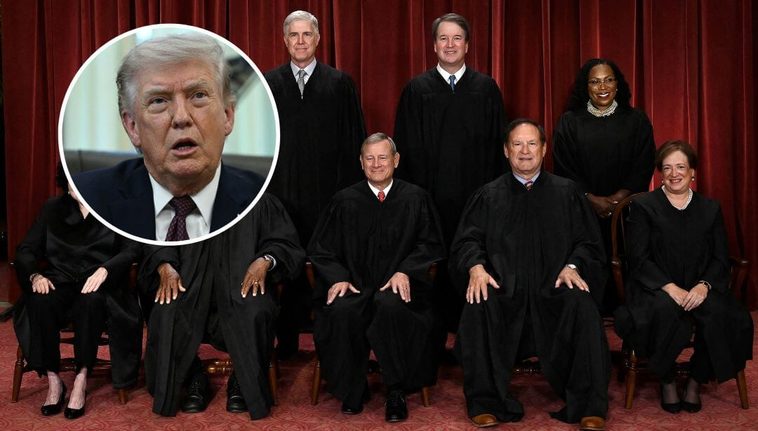
That injunction has now been swept aside by the Supreme Court’s ruling, clearing a major obstacle for the administration.
Meanwhile, enforcement numbers suggest a broader crackdown is already underway. According to DHS data, more than 527,000 individuals have been deported since Trump returned to office on January 20, 2025.
In addition, approximately 1.6 million people have voluntarily left the country out of roughly 2 million total departures, reflecting a surge in compliance as enforcement intensifies.
Officials within DHS say those figures are likely to rise further, particularly if Congress provides additional funding and resources to expand operations.
With the Supreme Court now backing executive authority on this issue, the administration appears poised to accelerate its immigration agenda—setting up what could be one of the most consequential policy battles of Trump’s second term.

