
>> Continued From the Previous Page <<
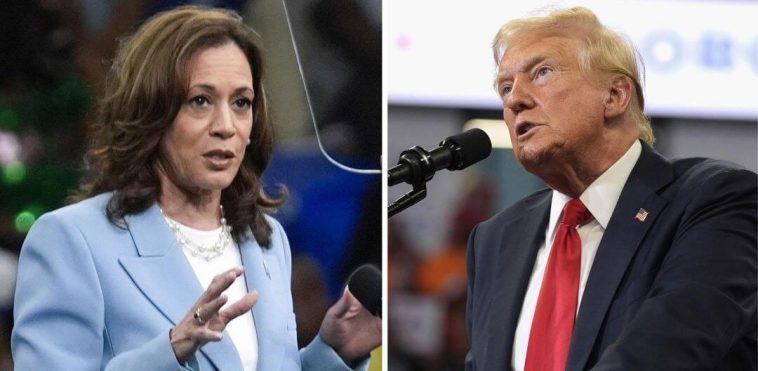
Brian Fallon, Harris’s senior adviser for communications, underscored their stance. “We have told ABC and other networks seeking to host a possible October debate that we believe both candidates’ mics should be live throughout the full broadcast,” Fallon stated. Fallon also speculated on the motivations behind Trump’s preference for a muted microphone format, suggesting that Trump’s team doubts his ability to maintain a presidential demeanor for the duration of the debate. “Our understanding is that Trump’s handlers prefer the muted microphone because they don’t think their candidate can act presidential for 90 minutes on his own. We suspect Trump’s team has not even told their boss about this dispute because it would be too embarrassing to admit they don’t think he can handle himself against Vice President Harris without the benefit of a mute button,” Fallon added.
In response to the Harris campaign’s push for open microphones, Trump’s camp has remained firm in their demand to stick to the previously agreed-upon debate rules. “Enough with the games. We accepted the ABC debate under the exact same terms as the CNN debate,” Trump campaign senior adviser Jason Miller asserted in a statement.

This brewing conflict over the debate format is just one of many dynamics shaping the 2024 presidential race. Recently, the race was shaken by Robert F. Kennedy Jr.’s decision to suspend his campaign and endorse Trump. Although RFK Jr. was only polling at around 5% nationally, his endorsement could be a pivotal factor in a tight race between Harris and Trump. The New York Post highlighted this potential impact, noting that “in a tight contest between Harris and Trump, that minor percentage could be what decides the presidency.”
Dave Wasserman, a senior editor at Cook Political Report, weighed in on the significance of Kennedy’s endorsement. “Most of Kennedy’s left-leaning support had already dispersed to Harris,” Wasserman said. “So this could represent a meaningful benefit for Trump.” According to Wasserman, the August survey data in battleground states revealed that “forty-six percent of RFK supporters went with Trump in a two-way race, 26% went with Harris, and Kennedy’s support had collapsed from 8% to 5% nationally.” He added, “Campaigns would spend hundreds of millions of dollars for a fraction of a point given how tight the margins are in these battleground states.”
Chris Lane, a pollster for Cygnal, echoed this sentiment, noting the potential impact of swing voters who previously supported RFK. “Among swing voters who will ultimately decide this election, 16% indicated they were going to vote for RFK,” Lane said. “With margins in battleground states being razor-thin, that 16% could represent the difference between winning and losing a state.” Lane emphasized that if RFK encourages his supporters to vote for Trump, it could “change the calculus for both Trump and Harris, especially in battleground states.”

Adding to this analysis, even anti-Trump pollster Frank Luntz acknowledged the possible significance of Kennedy’s endorsement. Luntz stated, “It’s probably worth about 1% for Trump, and that 1% could be everything if it’s in the swing states.” He pointed out that while some of Kennedy’s former supporters might abstain from voting in November, those who do vote are likely to favor Trump over Harris by a two-to-one margin. Luntz also criticized the media’s response to RFK’s endorsement, arguing that had Kennedy endorsed Harris, he would have been hailed as a hero. However, because Kennedy chose Trump, Luntz believes the media has downplayed his influence.
Carry 46 rounds concealed? (comfortably)
In the midst of these developments, pollster Scott Rasmussen, founder of Rasmussen Reports, observed a slight benefit for Trump in recent polling. “RMG Research polling for the Napolitan Institute this week showed Harris up 2 points 48% to 46% with RFK in the mix at 3%. When we pushed the RFK voters to make a choice, the race was tied at 49% at 49%,” Rasmussen said. He cautioned that while this suggests a small boost for Trump, other factors like the upcoming debate and economic trends could have a more substantial impact on the race.
Rasmussen concluded by noting that, given the historically tight margins in swing states, “any blip in support from RFK voters could be important.”
As the first Trump-Harris debate looms, the stakes are higher than ever. The ongoing microphone dispute, coupled with the unpredictable dynamics introduced by RFK’s endorsement, sets the stage for what promises to be a fiercely contested and closely watched presidential race.


I thought Kamala had to be the biggest dimwit in America but lo and behold someone by the name of Fallon jumped up to show me I was wrong. Trump is afraid to debate her with a live Mike because he can’t remain presidential that long. What a moron, Kamala can’t even enter the building as a serious candidate. What has America come too, when we offer her as an actual serious candidate. God help us.
The most important issue here is that Kamala is an anchor baby as her parents were NOT citizens of this country when she was born, thereby making her not allegeable to run for office as President.