
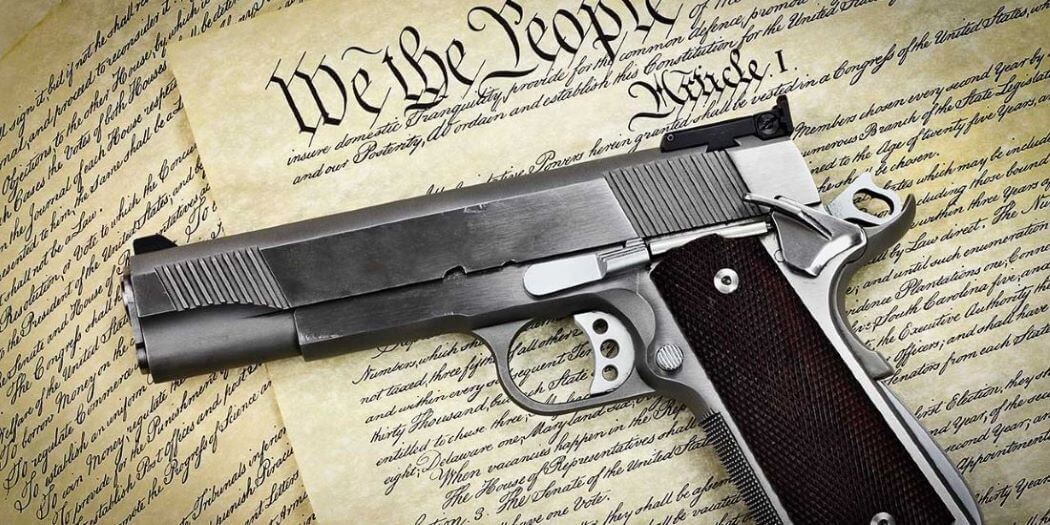
Christopher Wilson’s appeal for carrying a pistol in public without a permission was refused by the Hawaii Supreme Court, which pointed out that the state constitution does not provide the right to bear weapons in public.
Particularly in light of the U.S. Supreme Court’s major decisions in District of Columbia v. Heller (2008) and New York State Rifle & Pistol Association v. Bruen (2022), this result overturns a lower court’s decision that had upheld Wilson’s Second Amendment claim.
Don’t miss this! Carry faith with you everywhere with the Exclusive National Prayer Coin!

Wilson’s rights under the Second Amendment would be violated, the lower court determined in its ruling.
A broader constitutional controversy has been triggered by Wilson’s arrest on December 7, 2017, in the West Maui Mountains for carrying a loaded firearm without a permit.
Wilson’s legal defense, which cited the previous Bruen ruling, was first successful in the Circuit Court of the Second Circuit but was later overruled by the state Supreme Court. Many people consider this reversal—which maintains Hawaii does not recognize a constitutional right to carry a gun in public—to be a flagrant disrespect for long-standing federal Second Amendment precedent.

“Article I, section 17 of the Hawaiʻi Constitution mirrors the Second Amendment to the United States Constitution,” The Reload claims that the Hawaiian court wrote in Hawaii v. Wilson. “We read those words differently than the current United States Supreme Court. We hold that in Hawaiʻi there is no state constitutional right to carry a firearm in public.”
It added, “No doubt. Hawaiʻi’s historical tradition excludes an individual right to possess weapons. Hawaiʻi prohibited the public carry of lethal weapons – with no exceptions for licensed weapons – from 1833-1896. Unlicensed public carry of firearms has been illegal from 1896 to the present. Hawaiʻi has never recognized a right to carry deadly weapons in public; not as a Kingdom, Republic, Territory, or State.”
ALERT! Major Water Restrictions In Effect!
According to The Reload:
The majority findings at the heart of the Supreme Court’s precedents on gun rights are squarely at odds with the decision. The state supreme court’s decision expressly overturns the conclusions of the federal supreme court in the cases of New York State Rifle and Pistol Association v. Bruen in 2022 and District of Columbia v. Heller in 2008.
The Supreme Court of the United States may take up the case and admonish the lower court for its categorical rejection of the higher court’s Second Amendment jurisprudence. This is similar to what happened when the Massachusetts Supreme Court decided in the 2016 Caetano case that safeguards do not apply to contemporary firearms.
“There seems to us no doubt, on the basis of both text and history, that the Second Amendment conferred an individual right to keep and bear arms,” Most people wrote in Heller. Likewise, the Supreme Court decided in Bruen “the Second and Fourteenth Amendments protect an individual’s right to carry a handgun for self-defense outside the home.”
The Second Amendment’s rights against gun prohibitions are determined by a historical test set by the Supreme Court of the United States.
“[W]e hold that when the Second Amendment’s plain text covers an individual’s conduct, the Constitution presumptively protects that conduct,” the majority wrote in Bruen. “To justify its regulation, the government may not simply posit that the regulation promotes an important interest. Rather, the government must demonstrate that the regulation is consistent with this Nation’s historical tradition of firearm regulation. Only if a firearm regulation is consistent with this Nation’s historical tradition may a court conclude that the individual’s conduct falls outside the Second Amendment’s ‘unqualified command.’
Hawaiian justices used a scene from an HBO show to support their case for doing away with the norm.
“As the world turns, it makes no sense for contemporary society to pledge allegiance to the founding era’s culture, realities, laws, and understanding of the Constitution. ‘The thing about the old days, they the old days.’ The Wire: Home Rooms (HBO television broadcast Sept. 24, 2006) (Season Four, Episode Three).”
The position taken by the Supreme Court of Hawaii is not an anomaly; rather, it is a direct challenge to the US Supreme Court.
The state court has positioned itself against the interpretation of these rights by the nation’s top court by stating that the Second Amendment and its counterpart in the Hawaii Constitution do not guarantee an individual’s right to carry guns in public.
Leading voices such as Charlie Kirk contend that this decision creates a risky precedent, implying that state courts might arbitrarily disregard the Supreme Court’s decisions, in addition to misinterpreting the U.S. Constitution.
On X, Charlie Kirk wrote: “The Hawaii Supreme Court has issued a ruling flagrantly ignoring the U.S. Constitution, holding that there is no right to bear arms in Hawaii and any resident may be imprisoned for carrying one.”
“The Supreme Court has repeatedly held what the Constitution obviously says: That Americans have a constitutional right to bear arms. In D.C. vs. Heller (2008), they plainly stated this is an individual right, not a “collective right” (whatever that is). In McDonald vs. Chicago (2010), they held that his right applies to the states. In New York State Rifle and Pistol Assn. vs. Bruen (2020), they ruled that this right covers the public possession of handguns. But Hawaii’s court ignores all that, in favor of quoting HBO’s TV show “The Wire”: “The thing about the old days, they the old days.” Literally, that’s in the opinion.”
“The court also cites foreign laws, and Hawaii’s laws when it was still an independent kingdom, neither of which have any bearing on the state’s current laws or its obligations under the Constitution. In fact, the Hawaii Supreme Court essentially declares the entire Constitution null and void in their state, writing: “As the world turns, it makes no sense for society to pledge allegiance to the founding era’s culture, realities, laws, and understanding of the Constitution.” This is far more of a rebellion than anything that happened on January 6,” Kirk concluded.

