
>> Continued From the Previous Page <<
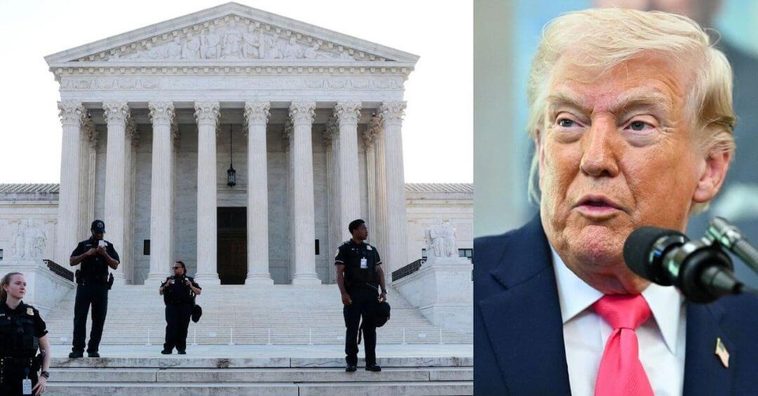
According to both Supreme Court records and the Supreme Court Historical Society, no sitting president has ever attended oral arguments before. While presidents have been present for ceremonial occasions, such as the swearing-in of appointees, attending a hearing is unprecedented.
Trump has previously participated in ceremonies confirming his nominees Neil Gorsuch and Brett Kavanaugh, but this marks his first foray into the courtroom during active proceedings.

The Supreme Court had announced in December it would hear the case, which challenges the longstanding constitutional principle granting U.S. citizenship to nearly all children born on American soil under the 14th Amendment.
At the heart of the case is whether the Citizenship Clause applies to children born to parents who are not legal residents. Plaintiffs argue the original intent of the 14th Amendment did not guarantee automatic citizenship to children of parents in the country illegally.
The justices agreed to take up the appeal after lower courts rejected challenges to the law. Observers expect oral arguments to center on historical evidence and the interpretation of Congress’s intent when the post-Civil War amendment was ratified.

Richard Pildes, a constitutional law professor at New York University, told NBC News that Trump’s personal attendance “certainly raises the temperature of the argument, which might be the President’s intent.”
“The case is about the powers of the presidency as an institution,” Pildes added. “By showing up in person, the President would instead be personalizing the case, as if it’s a personal confrontation between him and the justices.”
Historically, presidents have avoided attending oral arguments to prevent giving the impression that judicial decisions are tied to any individual officeholder rather than the presidency itself.
“They have understood it’s not good for the country to up the level of confrontation by representing the dispute as a more personalized one through showing up in person,” Pildes noted.
The case, Trump v. Barbara, directly challenges the legality of the executive order Trump signed on his first day back in office, January 20, 2025. The order eliminates automatic citizenship for children born to parents who are unlawfully in the U.S. or only temporarily present.
The Supreme Court’s decision to hear the case comes amid a heated national debate over immigration and border security. Supporters argue ending birthright citizenship would reduce illegal immigration, while critics warn it could leave thousands of U.S.-born children in uncertain legal status.
Analysts predict Wednesday’s session will be among the most closely-watched of the term, with potential consequences for millions and for long-standing immigration laws.
A ruling in Trump v. Barbara could fundamentally reshape federal immigration policy, raising questions about citizenship for children of non-lawful residents. The Supreme Court is not expected to issue a decision before late June, leaving the nation to watch closely in anticipation.

