
>> Continued From the Previous Page <<
“I am proud to announce that Kashyap ‘Kash’ Patel will serve as the next Director of the Federal Bureau of Investigation. Kash is a brilliant lawyer, investigator, and ‘America First’ fighter who has spent his career exposing corruption, defending Justice, and protecting the American People. He played a pivotal role in uncovering the Russia, Russia, Russia Hoax, standing as an advocate for truth, accountability, and the Constitution.
Kash did an incredible job during my First Term, where he served as Chief of Staff at the Department of Defense, Deputy Director of National Intelligence, and Senior Director for Counterterrorism at the National Security Council.
This FBI will end the growing crime epidemic in America, dismantle the migrant criminal gangs, and stop the evil scourge of human and drug trafficking across the Border.”
Trump’s endorsement has energized his supporters, but Democrats, including Durbin, see it as a dangerous politicization of the FBI.
Durbin fired back, arguing that Wray’s position is insulated from political influence and should remain so until his term concludes.

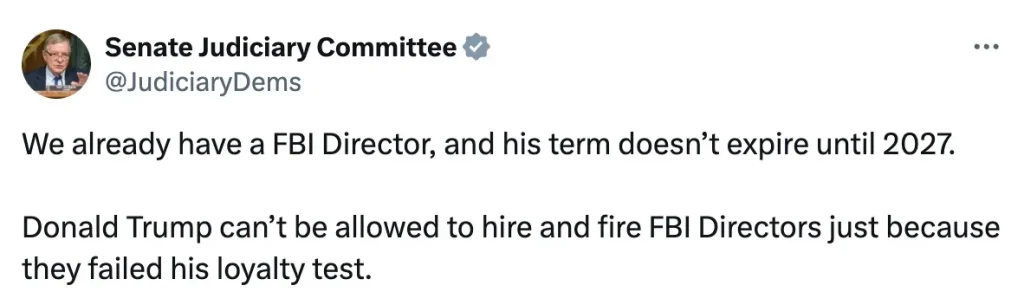
“We already have an FBI Director, and his term doesn’t expire until 2027. Donald Trump can’t be allowed to hire and fire FBI Directors just because they failed his loyalty test,” Durbin said in a statement.
He went further, asserting that Patel is unqualified for the role and accusing Trump of attempting to turn the FBI into a political tool.
Gold at $2,600… But This Stock Gives You More for Under $20
“President Biden kept Director Wray in office because the FBI is supposed to be insulated from partisanship. Now, the president-elect wants to replace his own appointee with an unqualified loyalist,” Durbin added.
The controversy highlights a broader constitutional debate about the President’s authority over executive branch officials. While FBI Directors are typically appointed to 10-year terms to ensure independence, the President has the constitutional authority to dismiss them.

Notable examples of presidential removals include:
- Bill Clinton (1993): Fired FBI Director William Sessions over ethical concerns.
- Donald Trump (2017): Fired FBI Director James Comey, citing dissatisfaction with his handling of investigations into Hillary Clinton and Russian interference.
Legal scholars argue that Article II of the Constitution grants the President the power to appoint and remove executive officials. Article II, Section 1 explicitly vests executive power in the President, while Section 3 requires the President to ensure laws are faithfully executed.
Despite these precedents, Durbin’s remarks have sparked a firestorm online, with critics accusing him of misunderstanding constitutional law. “This statement is not only baseless but ignorant of the fundamental powers of the presidency,” one observer remarked on social media.
As the debate rages on, Durbin faces mounting criticism for his defense of Wray and condemnation of Trump’s pick. Social media erupted with reactions, many ridiculing Durbin’s comments as misguided.
The unfolding saga underscores the intensifying partisan battle over the future of the FBI and its leadership. For Trump, Patel represents a fresh start for a bureau he has long criticized, while Democrats see the move as a threat to institutional integrity.
As 2027 approaches, the question remains: Can the FBI maintain its independence amidst increasing political interference? Or will the bureau become yet another battlefield in the war of American politics?

