
>> Continued From the Previous Page <<
“When Congress adopts a new law against the backdrop of a ‘long-standing administrative construction,’ the Court generally presumes the new provision works in harmony with what came before,” Gorsuch said.
Gorsuch further explained that since the 1950s, immigration regulations have generally excluded Sundays and legal holidays—later Saturdays—from deadline calculations. He noted that the 1996 Illegal Immigration Reform and Immigrant Responsibility Act uses the same methodology.

Joining Gorsuch in the majority were Chief Justice Roberts and Justices Sonia Sotomayor, Elena Kagan, and Ketanji Brown Jackson.
The ruling overturned the 10th Circuit Court of Appeals and the Board of Immigration Appeals, both of which had rejected this interpretation in the case of Monsalvo Velázquez, a 32-year-old Colorado resident who faced removal in 2019.
While the case revolves around procedural rules, the razor-thin 5-4 decision may serve as a bellwether for future high-profile immigration disputes. These include potential court challenges to due process protections for migrants and lawsuits opposing nationwide injunctions aimed at blocking former President Donald Trump’s birthright citizenship policies, according to Fox News.

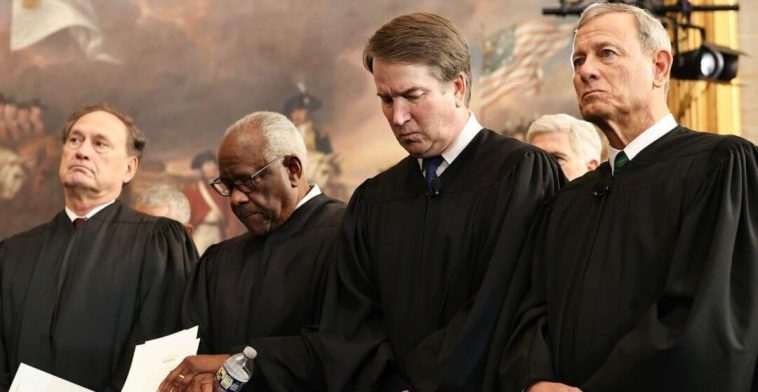
The dissenting justices—Clarence Thomas, Samuel Alito, Brett Kavanaugh, and Amy Coney Barrett—argued that the Supreme Court lacked jurisdiction to rule on the matter. Thomas would have sent the case back to the lower court for further review, while Barrett criticized the way Monsalvo filed the appeal.
Justice Alito, in a separate dissent, rejected the majority’s interpretation, insisting that the statutory 60-day period clearly includes weekends. “There will always be a sympathetic pro se alien who is a day or two late,” Alito wrote. “Unless the Court is willing to extend the statutory deadline indefinitely, it would presumably be forced to say in such cases that a day too late is just too bad.”
Alito added, “For this reason, sympathy for petitioner cannot justify the Court’s decision.”
The timing of the ruling is notable, coming just weeks before the Supreme Court is set to hear arguments on May 15 in a landmark case challenging Trump’s attempt to end birthright citizenship in the United States—a case many see as among the most consequential since Trump’s return to politics.
Meanwhile, border policy shifts under Trump have reportedly deterred migrants from attempting the journey to the U.S. After rescinding many of Biden’s open-border policies and reinstating measures like “Remain in Mexico,” illegal crossings have reportedly dropped dramatically.
According to a Reuters video report published this week, migrants who had begun their trek under the previous administration’s policies are now heading back home or reconsidering the journey entirely.
As the Supreme Court continues to weigh complex immigration cases, the balance between administrative technicalities and broad border enforcement policies remains under intense scrutiny—making each ruling a potential turning point for U.S. immigration law and national security.

