
>> Continued From the Previous Page <<
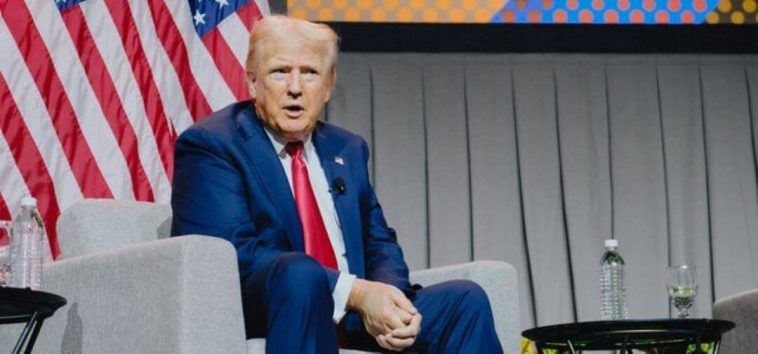
Below is a segment of the exchange:
Rachel Scott (ABC): “Some of your own supporters, including Republicans on Capitol Hill, have labeled Vice President Kamala Harris, who is the first Black and Asian-American woman to serve as Vice President, as a DEI hire. Is that acceptable language to you? And will you tell those Republicans and those supporters to stop it?”

Donald Trump: “How do you define DEI? Go ahead.”
Rachel Scott: “Diversity, equity, inclusion.”
Donald Trump: “Okay, go ahead. Is that your definition?”
Rachel Scott: “That is literally the word.”
Donald Trump: “Give me a definition then… Would you give me a definition?.. Give me a definition.”
Rachel Scott: “Sir, I’m asking you a question, a very direct question.”
Donald Trump: “No, you have to define it. Define it for me, if you wish.”
Rachel Scott: “I just defined it, sir. Do you believe that Vice President Kamala Harris is only on the ticket because she is a Black woman?”
Donald Trump: “Well, I can say no. I think it’s maybe a little bit different. I’ve known her a long time indirectly, not directly, very much. She was always of Indian heritage, and she was only promoting Indian heritage. I didn’t know she was Black until a number of years ago when she happened to turn Black, and now she wants to be known as Black.
I don’t know, is she Indian or is she Black? She is always identified as Black. I respect either one, but she obviously doesn’t because she was Indian all the way, and then all of a sudden, she made a turn, and she went, she became a Black person.”
WATCH:
Trump’s remarks touch on a long-standing discussion regarding Kamala Harris’s racial identity. Born to an Indian mother and a Jamaican father, Harris has often embraced both heritages. However, her racial identity has been a focal point in political discussions, especially given her historic role as the first Black and Asian-American woman to serve as Vice President.
Carry 46 rounds concealed? (comfortably)
The term DEI, which stands for Diversity, Equity, and Inclusion, was a central point of the exchange. Critics and supporters alike have debated whether Harris’s selection as Vice President was influenced by her racial and ethnic background. Rachel Scott’s questioning aimed to probe Trump’s stance on this matter, reflecting broader conversations about affirmative action and representation in politics.
Trump’s interaction with Rachel Scott is emblematic of his broader relationship with the media, particularly outlets he deems as purveyors of “fake news.” His insistence on a clear definition of DEI before answering the question underscores his often combative approach to media interviews.
Trump’s comments at the NABJ conference have once again ignited discussions on race, identity, and political representation. While his remarks about Harris’s racial background were controversial, they highlight ongoing debates about how identity politics shapes public perception and political careers in America.
As the nation continues to grapple with issues of race and representation, moments like these at public forums underscore the importance of open dialogue and the need for clarity in discussing complex identities. Trump’s engagement with the media, marked by his direct and often provocative style, ensures that these conversations remain at the forefront of public discourse.

