
>> Continued From the Previous Page <<
Greene launched into a vehement critique of Fauci, starting with his approval of controversial experiments involving dogs. She expressed her disgust and labeled the actions as “disgusting and evil,” stressing that such experiments were an inappropriate use of American taxpayer money.
“GREENE: As director of the NIH, you signed off on these so-called scientific experiments. And as a dog lover, I want to tell you this is disgusting and evil!”

Expanding her criticism, Greene then accused Fauci of profiting from his position through royalties received from drug companies, a point she underscored by citing a report that claimed NIH scientists earned significant sums in royalties. She challenged the ethics of such payments, particularly when linked to public health guidelines that affect millions.
“GREENE: You also told people they had to ‘distance’ by six feet, they needed to wear masks. Let’s also talk about the ‘science’ that you like to represent.”
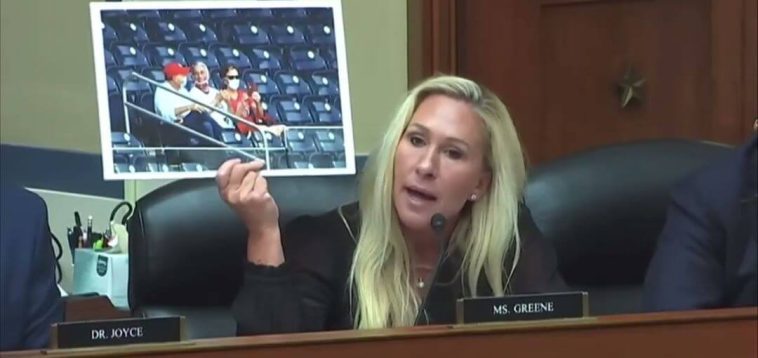
The confrontation peaked when Greene displayed a widely circulated photo of Fauci at a baseball game without a mask, questioning his adherence to the very guidelines he promoted. Her refusal to acknowledge his medical title further fueled the controversy, leading to objections from Democratic members.
“RASKIN: Mr. Chairman, objection, Mr. Chairman, objection.”
As the debate grew more heated, Wenstrup had to intervene several times to maintain order and remind members of the rules of decorum. Despite these efforts, the session veered into deeper conflict, highlighting the polarized views on Fauci’s legacy and the government’s pandemic response.
Reveal the Biblical Wealth Protection Secret—Take Action Now to Secure Your Money!
“UNNAMED DEMOCRAT: Is this what we have become? Is this what we have devolved into? No decorum.”
Ultimately, the hearing underscored the ongoing political and social divisions surrounding the pandemic’s management. While some view Fauci as a respected scientist who guided the country through a crisis, others, like Greene, see his actions as fundamentally flawed and deserving of severe scrutiny.
This session not only reflects the contentious nature of U.S. politics today but also the challenges of public health leadership in times of crisis. As debates like these continue, they serve as a stark reminder of the deep divides that can influence public health policies and the interpretation of scientific data.

