
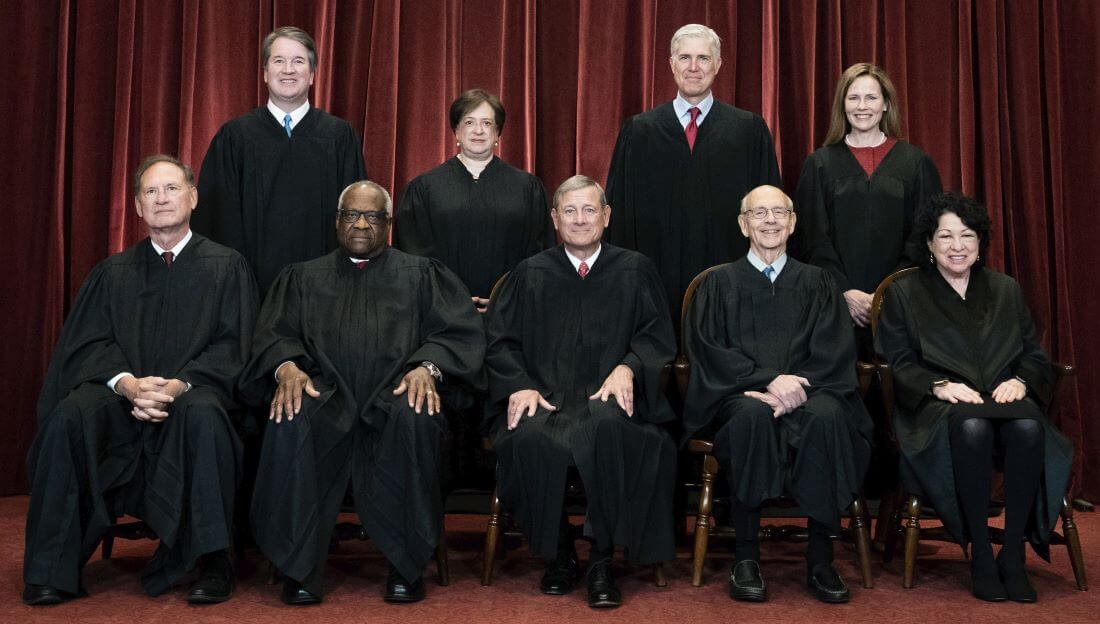
Experts have remarked that the U.S. Supreme Court heard two cases this week that might put a stop to a four-decade “constitutional revolution” that started under the Reagan administration.
The rulings in these cases might have a big influence on how federal agencies interpret legislation that Congress has established. This may severely restrict their ability to enact laws through rules.
Don’t miss this! Carry faith with you everywhere with the Exclusive National Prayer Coin!

Midway through President Ronald Reagan’s two terms in 1984, Thomas M. Boyd, a former US assistant attorney general under Reagan, claimed that Justice John Paul Stephens’ opinion in the case of Chevron U.S.A. v. National Resources Defense Council began what legal scholar Gary Lawson would later characterize as “nothing less than a bloodless constitutional revolution.”
The decision significantly changed the way that “ambiguous” statutes may be interpreted by government authorities. This shift made it possible for succeeding presidential administrations to impose policies that occasionally deviated from the exact wording of legislation that Congress had authorized. These policies functioned as de facto laws.
However, as Boyd pointed out in a New York Post piece, “At long last, on Wednesday, the Supreme Court will hear two cases that may signal the beginning of the end to that revolution.”
Boyd pointed out that the Constitution’s Article I states clearly, “All legislative power herein granted shall be vested in a Congress of the United States” not government oversight organizations.
But he continues, Justice Stephens’ ruling indicated that “agenc[ies] may . . . properly rely upon the incumbent administration’s views of wise policy” in “reasonably” describing ambiguities in statutes.
Stephens believed that the Executive Branch, which includes presidents and the people they designate, has the power to interpret laws established by the Legislative Branch in a way that makes sense.
Boyd pointed out that this was important to the Chevron ruling and became known as the “Chevron defense, leading President Ronald Reagan’s White House counsel, Peter Wallison, to describe it as “the single most important reason the administrative state has continued to grow out of control.”
ALERT! Major Water Restrictions In Effect!
Boyd writes: “Forty years of regulatory and judicial tumult have ensued, finally crescendoing to a point that has compelled the Supreme Court to intervene.
Loper Bright Enterprises v. Raimondo, from the District of Columbia Circuit, and Relentless v. Department of Commerce, from the First Circuit, are now before the court. Both are companies that fish for herring in New England and are family-owned and operated, and both are subject to the Magnuson-Stevens Act, which governs fishery management in federal waters. The act allowed the National Marine Fisheries Service to require herring boats, relatively small vessels that normally carry only five to six people, to also carry federal monitors to enforce its regulations.”
Things go wrong in this case.
Reagan’s former assistant attorney general brought attention to the fact that the agency proceeded to force Loper Bright and Relentless to pay for the monitors’ wages in the absence of a clear legal obligation. The NMFS reported that these expenses were $710 per day, often more than the money that was made from fishing.
The federal circuit courts determined that the lack of a statute on the subject constituted a “ambiguity” necessitating the use of the Chevron deference.
Nevertheless, the justices suggested a two-part inquiry that plaintiffs would have to respond to when the Supreme Court granted certiorari in both cases: “Whether the Court should overrule Chevron or at least clarify that statutory silence concerning controversial powers expressly but narrowly granted elsewhere in the statute does not constitute an ambiguity requiring deference to the agency.”
Boyd emphasized that several of the court’s justices—constitutionalist originalists, to be exact—have already spoken their thoughts on the matter.
The overwhelming power granted to the Executive Branch and government agencies worries a lot of people. Boyd claims that the issue stems from their expansive interpretation of the law, which gives them virtually unchecked power in government.

