
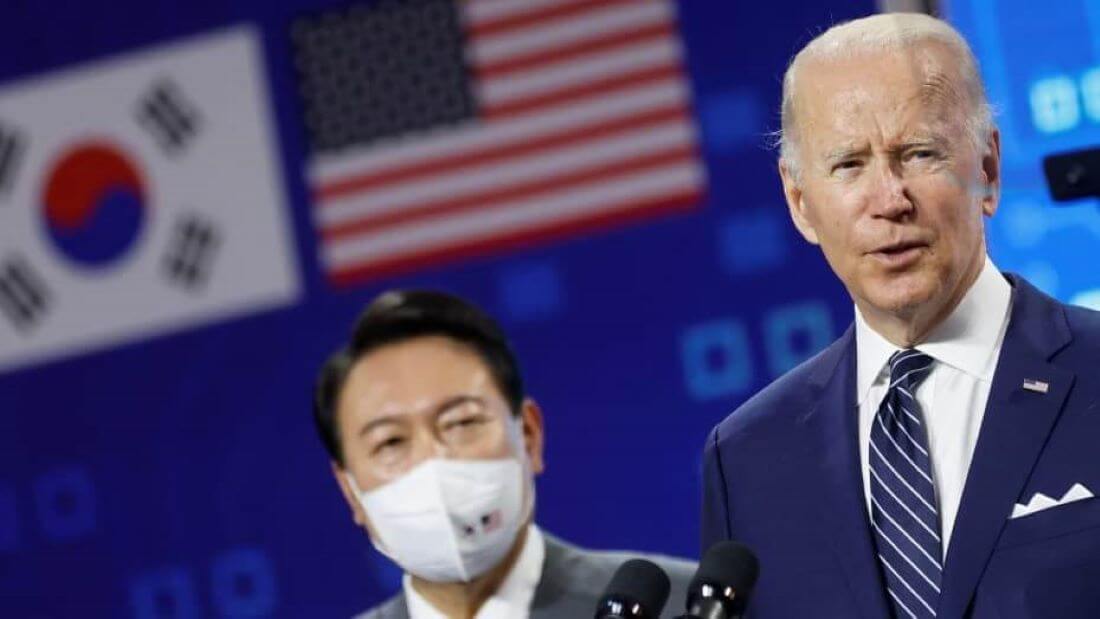
The espionage scandal threatens to sour relations with longtime ally South Korea, which has hampered the Biden administration’s diplomatic efforts. This is particularly unfortunate since it complicates the administration’s already challenging foreign policy environment.
The United States is dealing with two pressing issues that require quick response among the present worldwide unrest. Their tactics are being put to the test as they negotiate the delicate situation in the Taiwan Strait with China and the proxy conflict meant to support Ukraine in its ongoing battle against Russian aggression. The world is eagerly awaiting the United States’ approach to these challenging problems because the stakes are so high.
JUST IN: Trump 24K Golden Dollars – Available Now!

A fresh espionage scandal is in progress and is being disclosed by Department of Defense papers that were leaked on social media. “Pentagon Papers, sheds light on the diplomatic tightrope that the Biden administration has been treading to manage both conflicts.
When The New York Times verified the veracity of the Pentagon Papers leak, it created a stir in the media community. While readers were free to establish their own conclusions regarding the report’s contents, the newspaper’s reliable sourcing gave its publishing more weight.
The new revelation in The Times illuminates South Korea’s opposition to becoming involved in a proxy conflict with Russia. Their reluctance to provide ammo to the United States because it may eventually be sent to Ukraine is the main problem at hand.

“When reports emerged late last year that South Korea had agreed to sell artillery shells to help the United States replenish its stockpiles, it insisted that their ‘end user’ should be the U.S. military,” the report states. “But internally, top aides to President Yoon Suk Yeol were worried that their American ally would divert them to Ukraine.”
The principal foreign advisors of South Korean President Yoon Suk Yeol were “mired in concerns that the U.S. would not be the end user if South Korea were to comply with a U.S. request for ammunition.”
Controversially, the “secret report was based on signals intelligence, which meant that the United States has been spying on one of its major allies in Asia,” the Times noted.
In an unexpected turn of events, Yi Mun-hui, the secretary for foreign affairs, and Kim Sung-han, the national security adviser, both of South Korea, both resigned last month for “unclear reasons.”
According to a Times story, a group of opposition politicians accused the United States of espionage at a press conference they conducted in South Korea. They said that information in the released papers might be “just the tip of the iceberg,” and they “strongly urged Washington to launch an investigation and ensure that similar acts did not happen again.”
“This is a clear violation of our sovereignty by the United States and a super-scale security breach on the South Korean part,” the lawmakers said.
In spite of South Korea’s government’s policy of delivering weapons during times of combat, the Biden administration may have put pressure on them to provide lethal help, according to the Pentagon Papers that were just made public. The complex political factors at play are made clear by this new material, which also raises concerns about diplomatic procedures.
According to the Times, former national security adviser Kim “suggested the possibility” of selling Poland 330,000 rounds of 155-millimeter artillery shells. Kim also said “getting the ammunition to Ukraine quickly was the ultimate goal of the United States.”
Yi, a former secretary of state for foreign affairs, said Poland may agree to accept the label of “the end user” in order to transport the ammunition to Ukraine, but that South Korea would need to “verify what Poland would do.” This agreement would, however, go against South Korea’s national policy that prohibits providing military support to belligerent nations.
Yang Uk, a respected weapons expert who works at the Asan Institute for Policy Research in Seoul, has provided The Times with insightful commentary on recent findings.
“South Korea’s position has been that it will cooperate with the United States while not clashing with Russia,” he said, adding, “The documents leaked put South Korea in a more difficult position.”
He discussed the wide-ranging repercussions of the recent revelation that the United States has been watching its ally during the conversation.
“It’s reasonable to suspect that the United States spies on top defense and security officials in Seoul, but it’s bad news for the general public ahead of the South Korea-U.S. summit,” he added. “People will ask, ‘We have been allies for seven decades, and you still spy on us?’”

