
>> Continued From the Previous Page <<
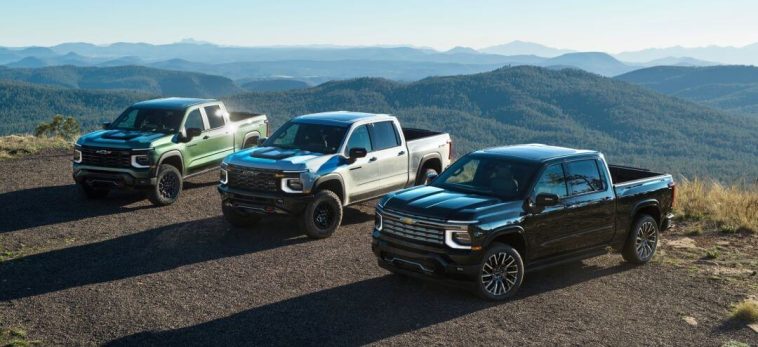
After spending years promoting an electric future and investing billions in EV development, the company recently absorbed massive losses tied to its electric vehicle ambitions. At the same time, demand for traditional trucks and V8-powered vehicles has remained remarkably strong.
Now Chevrolet appears to be responding to what buyers have been saying all along.

The centerpiece of the announcement is the return of the 350 cubic-inch V8.
Originally introduced in 1967, the 350 quickly became one of the most successful engines ever produced. It powered everything from Camaros and Corvettes to pickup trucks and family vehicles. Over the decades, millions of Americans learned to drive behind the rumble of a Chevy 350.
When GM redesigned the Silverado for the 1999 model year, the company phased out the beloved engine in favor of newer powerplants. That decision marked the end of an era.
Now, nearly three decades later, the famous displacement is returning.
The new 5.7-liter V8 will effectively replace the outgoing 5.3-liter engine that has served as the backbone of Chevrolet’s truck lineup for years. Industry analysts expect power output to approach 400 horsepower, representing a meaningful upgrade for truck owners who prioritize towing, hauling, and reliability.
Joining it will be a larger 6.6-liter V8, a modern powerplant that effectively revives the legendary 400 cubic-inch designation. Chevrolet has not officially released final performance figures, but early reports suggest output could reach approximately 475 horsepower.
If those estimates prove accurate, the Silverado could offer some of the strongest naturally aspirated V8 performance available in the half-ton truck segment.
The third member of Chevrolet’s V8 revival may be the most historically significant.
Earlier this year, GM announced the LS6 engine for the upcoming 2027 Corvette Grand Sport. That 6.7-liter powerhouse translates almost perfectly to 409 cubic inches—a number that holds a special place in Chevrolet history.
The original 409 became famous during the muscle car era and helped establish Chevrolet as a dominant force in American performance. Its reputation became so legendary that it even inspired one of the most recognizable songs of the early 1960s.
For the first time in decades, the 350, 400, and 409 names will exist together in Chevrolet’s lineup.
GM executives insist these engines are far more than nostalgia projects.
According to Silverado Chief Engineer Mark Dickens, Chevrolet subjected the new powerplants to extensive testing designed to replicate real-world truck use, including heavy towing and demanding work conditions.
The company also says it has taken steps to improve durability and restore consumer confidence after reliability concerns involving previous engine designs. Production will take place in North America, including facilities in New York, Ontario, and Michigan.
The timing of the announcement is impossible to ignore.
While competitors continue relying largely on existing V8 architectures, Chevrolet is investing heavily in entirely new gasoline-powered engines. Ford’s 5.0-liter V8 has remained largely unchanged for years, while Ram recently turned back to a familiar Hemi platform rather than launching an all-new design.
That leaves GM as the only major player currently introducing completely new V8 technology in the full-size truck market.
The bigger story, however, may be what this says about consumer demand.
For years, Americans were assured that electric trucks would rapidly replace traditional pickups. Yet truck buyers repeatedly demonstrated that capability, affordability, range, and proven performance still matter.
Recent EV sales figures have reinforced that reality.
As government subsidies disappear and consumers face the true cost of electric trucks, demand has cooled considerably. Meanwhile, traditional pickups continue dominating sales charts across the country.
Perhaps most surprising is that Chevrolet reportedly began developing these engines in 2023—during the same period the company was publicly discussing ambitious plans for an all-electric future.
Now those plans look very different.
The return of the 350, 400, and 409 is more than an engineering announcement. It represents a major acknowledgment that American consumers never abandoned the V8.
Despite years of pressure from regulators, activists, and corporate planners, truck buyers continued choosing the powertrains they trusted.
And now one of America’s most iconic automakers is giving them exactly what they asked for.
The V8 isn’t disappearing.
It’s making a comeback.

