
>> Continued From the Previous Page <<
One example stood out in particular—a collectible Colt revolver that could have fetched hundreds of dollars, yet was nearly traded in for just a $50 card before being destroyed.
That’s where State Delegate S. Chris Anders stepped in.

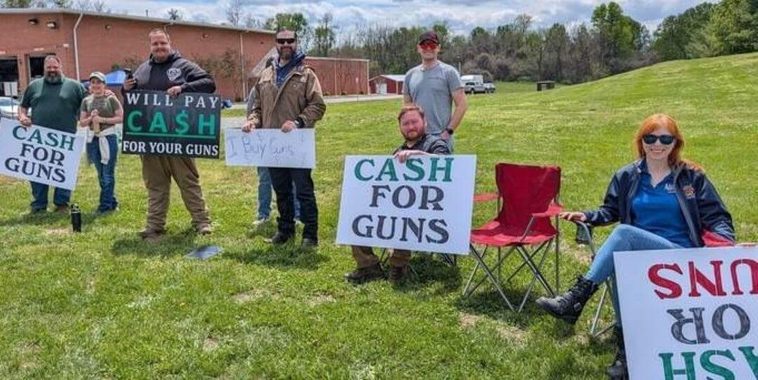
Anders arrived at the event with a licensed firearms dealer and a Class III dealer, ensuring full compliance with federal, state, and local regulations, including the National Firearms Act. But instead of participating in the destruction process, his team set up an alternative option for gun owners: cash payments based on actual market value.
The presence of a competing offer immediately changed the atmosphere of the event.
Supporters of the church’s program reportedly contacted law enforcement, prompting officers to respond and assess the situation. After reviewing what was taking place, authorities determined that Anders and those working with him were operating fully within the law.
From Anders’ perspective, the goal was never confrontation—it was transparency and choice.
“What we did was peaceful, lawful, transparent and rooted in liberty,” Anders told the Daily Caller News Foundation.
Despite claims from organizers that the “overwhelming majority” of participants chose to surrender their firearms for destruction in exchange for gift cards, observers noted that numerous attendees instead opted to take cash offers from Anders’ team. In those cases, firearms were preserved rather than destroyed, and owners walked away with significantly higher compensation.
The West Virginia Freedom Caucus, which Anders chairs, later confirmed that several firearms—including the previously mentioned Colt revolver—were ultimately saved from destruction after owners accepted fair-market offers.
Instead of accepting a $50–$200 gift card, many participants left with real cash value for their property, avoiding what critics describe as artificially low pricing structures typical of buyback programs.
The broader significance of the event extends well beyond a single church parking lot in West Virginia.
Gun buyback programs have existed for decades, often marketed as “buybacks,” even though organizers never owned the firearms in the first place. Critics argue the term itself is misleading, since the programs involve purchasing privately owned property at fixed prices that rarely reflect true market demand.
The system, they say, depends heavily on three assumptions: that gun owners do not know the value of their firearms, that they are not presented with competing offers, and that the destruction of firearms is the only outcome available.
At Shepherdstown, those assumptions were challenged in real time.
“One of the biggest misconceptions pushed by gun control activists is that firearms themselves are evil objects,” Anders told the DCNF. “A firearm in the hands of a peaceful citizen is a tool.”
That argument lies at the center of the broader Second Amendment debate—whether firearms should be viewed primarily as dangerous objects to be eliminated, or as tools whose value depends on the person using them.
Anders also pointed to the church’s own messaging, noting its public emphasis on progressive social causes alongside its participation in the destruction-focused event. In his view, the program reflected a broader ideological push rather than a purely community-driven initiative.
“Every gun melted down is proof that some people would rather destroy freedom than defend it,” Anders said.
Following the event, Anders encouraged Second Amendment supporters to replicate the strategy elsewhere, arguing that simply offering fair-market alternatives could significantly disrupt similar gun destruction programs across the country.
The implications are hard to ignore. If one competing table and one licensed dealer can change outcomes at a single event, it raises questions about how many firearms have been surrendered in past buybacks without owners ever being presented with a better option.
For decades, these programs have operated with little resistance. The Shepherdstown event suggests that may no longer be the case.
No new legislation was required. No court ruling was needed. Just a competing offer—and a reminder that in a free market, value often speaks louder than slogans.

