
>> Continued From the Previous Page <<
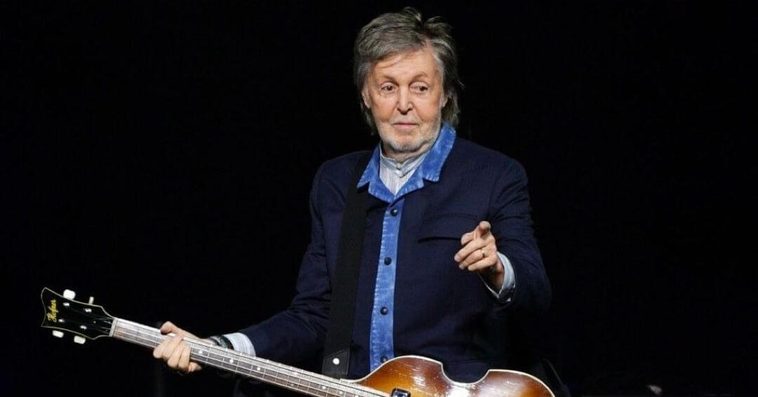
“Particularly these days, you do something like ‘Hey Jude’ and you see this whole audience singing together,” McCartney told The Rest Is Entertainment podcast this week.
That observation alone would have been unremarkable. But then came the line that quickly became the focal point of discussion across media and social platforms.

“I mean, in Trump’s America, and the Republicans and Democrats all at each other’s throats – when we do that song, they’re not,” he said.
The phrasing stood out immediately. Not “divided America.” Not “polarized America.” He specifically used the term “Trump’s America”—a phrase often deployed in political discourse as shorthand for division—and applied it to a moment of unexpected harmony.
“They’re all loving it, and it’s like, ‘Wow, this is pretty amazing,’” McCartney added.
The implication was not condemnation, but contrast: a politically fractured nation momentarily set aside its disagreements inside a concert hall, unified by music that transcends ideology.
What makes the remark more striking to observers is McCartney’s long-standing political leanings. The former Beatle is widely known as a lifelong liberal and has historically supported Democratic candidates in both the United States and abroad. He is also a British knight whose cultural influence spans generations and continents. Yet his recent comments did not echo the typical political framing often associated with the phrase he used.
Instead, he appeared to describe something simpler—and more human: a shared cultural moment that defies political categorization.
In that sense, McCartney’s remarks were interpreted by some as an accidental challenge to the long-standing narrative that “Trump’s America” is defined solely by dysfunction or irreparable division. Whether intentional or not, his words suggested that unity still exists in places often overlooked by political commentary.
While McCartney highlighted moments of cohesion from the stage, another legendary figure of American music was navigating a far more politically charged week.
Bruce Springsteen had launched his “Land of Hope and Dreams American Tour” earlier in the year, a run of shows explicitly framed around opposition to Donald Trump and his administration. During performances, Springsteen has made frequent political statements, including calls for audiences to choose “democracy over authoritarianism” and “truth over lies.”
He also released “Streets of Minneapolis,” a track widely interpreted as a protest against immigration enforcement policies.
But following a high-profile security incident at the White House Correspondents’ Association Dinner, Springsteen’s tone shifted during a live appearance in Austin, Texas. In a notable moment, he offered a public prayer for the president and others in government.
“We send out a prayer of thanks that our president, nor anyone in the administration, nor anyone attending, was injured at last night’s incident,” Springsteen told the crowd.
He continued with a broader condemnation of violence in politics, stating: “There is no place in any way, shape, or form for political violence of any kind in our beloved United States.”
The moment stood out not because of what was said, but because of who said it—an artist who has spent much of his recent tour sharply criticizing the Trump administration now publicly extending prayers for its safety.
Taken together, the comments from McCartney and Springsteen offer an unusual cultural snapshot. Neither man is aligned with conservative politics. Neither has been known as a supporter of Donald Trump. Yet both, in different ways and for different reasons, acknowledged themes that transcend partisan boundaries: unity in public life, and the rejection of political violence.
For McCartney, the takeaway was rooted in observation rather than ideology. In a divided era, he pointed to a concert hall where strangers of opposing political beliefs stood side by side, singing in unison without conflict.
For Springsteen, it was a reminder—delivered in the aftermath of real-world tension—that even amid political disagreement, certain lines should not be crossed.
The contrast between the two men’s public moments underscores a broader cultural reality. While political discourse in the United States often emphasizes division, moments of shared experience continue to surface in unexpected places: concerts, sporting events, and communal gatherings where ideology briefly fades into the background.
And perhaps that is why McCartney’s phrase resonated so widely. Whether intended as commentary or casual observation, his words captured something many Americans recognize but rarely hear acknowledged from such an iconic figure.
In describing a crowd united in song, he didn’t frame it as nostalgia or escapism. He framed it as reality.
“I mean, in Trump’s America…”
And then, unexpectedly, he described something closer to harmony than conflict.

