
>> Continued From the Previous Page <<
The legislation, formally known as the Safeguard American Voter Eligibility Act, would require individuals registering to vote in federal elections to provide proof of U.S. citizenship. Republicans have rallied around the proposal, arguing that stronger safeguards are necessary to restore confidence in America’s election system ahead of the critical 2026 midterms.
For conservatives, the issue has become one of the defining political battles of the post-2024 landscape.

While Democrats insist current election laws already prohibit noncitizens from voting and claim instances of illegal voting are extremely uncommon, Republicans argue the system remains vulnerable and lacks basic protections supported by the overwhelming majority of Americans.
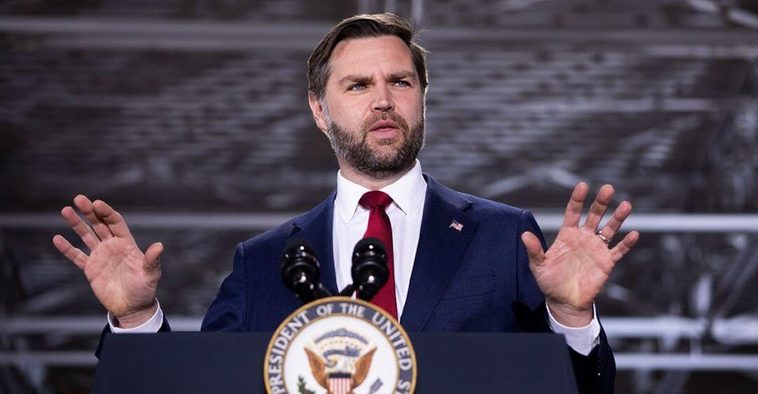
Vance framed the debate as part of a larger fight over who Washington politicians truly represent.
“I’m not asking you to vote for Republicans because we’re right about everything,” Vance said. “I’m asking you to vote for Republicans because at least we know who we fight for. And we fight for you.”
The vice president also accused Democrats of placing the interests of illegal immigrants and political activists ahead of ordinary American citizens, echoing arguments that have become central to Republican messaging on immigration and election security since President Donald Trump returned to the White House.
Behind the scenes, tensions inside the GOP continue to grow.
Many conservative voters and Trump allies are increasingly frustrated that Senate Republicans have not yet managed to force the SAVE Act through Congress despite holding a majority in the chamber. The internal dispute has largely centered around the Senate filibuster, which currently requires 60 votes for most legislation to advance.
Trump has repeatedly pressured Senate Majority Leader John Thune to either weaken or eliminate the filibuster in order to pass election-security reforms with a simple majority vote.
Thune, however, has resisted calls for dramatic procedural changes, warning that Republicans currently lack enough support within their own conference to dismantle the long-standing Senate rule.
That hesitation has infuriated many Trump-aligned conservatives, who argue Republicans are failing to fully utilize the power voters handed them in Washington.
Conservative commentator Deroy Murdock blasted Senate Republicans this week, accusing them of lacking urgency and strategic focus in the fight over election integrity.
Writing in a sharply worded opinion piece, Murdock proposed a far more aggressive approach designed to force Democrats into repeated public votes on citizenship verification and voter ID protections.
“Speaker Mike Johnson should staple the SAVE America Act to every single piece of legislation that the House sends the Senate,” Murdock wrote.
Such a strategy would dramatically increase political pressure on Senate Democrats while also forcing moderate Republicans to publicly take sides every time major legislation reaches the Senate floor.
At the same time, the SAVE Act battle has become deeply intertwined with the growing Republican war against the filibuster itself.
Trump, billionaire entrepreneur Elon Musk, and Mike Lee have all recently argued that Democrats are using Senate rules to obstruct conservative priorities despite repeated Republican victories at the ballot box.
Lee, in particular, has become one of the most vocal critics of the 60-vote threshold.
“Enough excuses. Nuke the filibuster. Start passing bills,” Lee recently declared.
Republicans also argue Democrats would move swiftly to abolish the filibuster themselves if they regained unified control of Washington and sought to pass sweeping federal election laws, add new states such as Washington, D.C., or expand the Supreme Court.
With the 2026 midterm elections approaching, the SAVE Act is quickly emerging as both a legislative battle and a political loyalty test inside the Republican Party.
Supporters of the measure point to polls showing strong public backing for voter ID laws and citizenship verification requirements, while Democrats continue warning the legislation could complicate voter registration for eligible Americans.
For Trump allies and grassroots conservatives, however, the issue now represents something much larger than a single bill. It has become a symbol of whether Republicans are truly willing to fight aggressively for the agenda voters sent them to Washington to accomplish.

