
>> Continued From the Previous Page <<
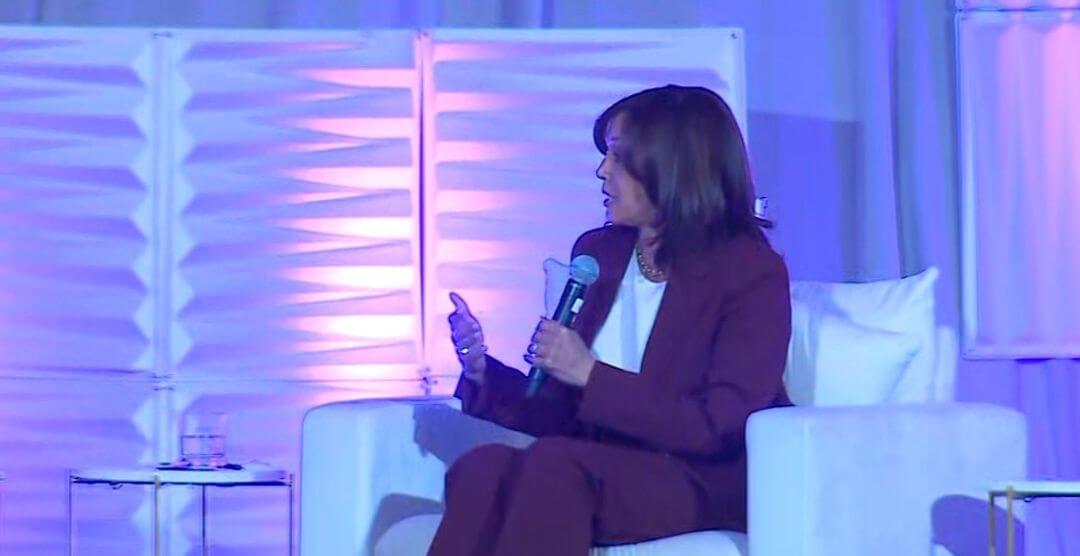
During her remarks, Harris encouraged voters to think more directly about personal benefit when engaging in politics. She told the audience:
“I think it’s okay for us to be a bit transactional, too,” she said, slipping into a cadence she does not use anywhere else.

“And to say, ‘I’m gonna get mine also.'”
It was that delivery—specifically the shift in tone and rhythm—that reignited scrutiny. Critics and online observers quickly pointed out that the vocal style seemed to contrast sharply with how she typically speaks in other settings.
Accents, Adjustments, and Political Optics
This is not the first time Harris has faced questions about changes in her speaking style depending on her audience or venue. During the 2024 campaign cycle, similar moments were widely circulated online. At the Congressional Black Caucus dinner, observers noted a distinct shift in her speech pattern. Weeks later, at a Philadelphia church event, she delivered scripture references in a manner some described as markedly different from her earlier campaign appearance that same day.
Political commentator Stephen Miller previously claimed he identified multiple distinct speech patterns over a short stretch of the campaign season, though supporters argue that such variations are simply natural adjustments in tone and delivery.
Harris, who grew up in Berkeley and spent part of her childhood in Montreal, has long been comfortable code-switching in public environments. Still, critics say the frequency and contrast of these shifts stand out more than typical political adaptation.
Campaign Style or Something Else?
To many observers, adjusting tone for different audiences is a normal part of political communication. Most candidates, regardless of party, tailor their language depending on the setting, audience demographics, or formality of the event.
However, critics argue Harris’s shifts go beyond standard adaptation. They say the changes appear more pronounced, almost as if an entirely different speaking persona is being deployed in certain environments.
Supporters of the Vice President reject that interpretation, arguing that the criticism is overstated and politically motivated. The White House previously dismissed similar questions during the 2024 cycle. When Fox News’ Peter Doocy raised concerns about Harris’s Detroit speech style, press secretary Karine Jean-Pierre responded by calling the line of questioning:
“just insane.”
Despite the pushback, video clips comparing Harris’s different appearances continued circulating widely online, keeping the debate alive.
The 2028 Question Looms Larger
Beyond the stylistic debate, Harris’s recent public appearances are being viewed through an increasingly political lens. Just two weeks before the Chicago event, she spoke at the National Action Network convention, where Reverend Al Sharpton directly asked her about a possible 2028 presidential run.
“Listen, I might,” she said. “I’m thinking about it.”
Since then, Harris has made multiple visits to key early primary states, including South Carolina, Georgia, and North Carolina—moves that have only intensified speculation about her national ambitions. Her decision not to enter the California governor’s race was also widely interpreted in political circles as leaving the door open for another presidential bid.
A Message Focused on Transactional Politics
The broader message delivered in Chicago may prove just as significant as the optics surrounding her delivery. Her encouragement for voters to consider what they personally gain from political engagement has been interpreted by critics as a blunt, transactional framing of civic participation.
To supporters, it reflects political realism in an era where voters increasingly demand tangible results. To critics, it signals a lack of broader vision—an appeal based less on ideology or policy direction and more on immediate benefit.
A Defining Contrast Heading Into the Next Election Cycle
Whether viewed as strategic communication or political inconsistency, Harris’s public appearances continue to generate strong reactions across the political spectrum. The contrast between settings, tone, and messaging has become a recurring point of discussion, especially as speculation grows about her future ambitions.
For Republicans watching the unfolding narrative, the controversy is being interpreted as an opening rather than a liability. For Democrats, it presents a messaging challenge heading into a volatile political landscape.
Either way, the Chicago appearance ensured one thing: Kamala Harris remains firmly at the center of the national political conversation, whether for what she says—or how she says it.

