
>> Continued From the Previous Page <<
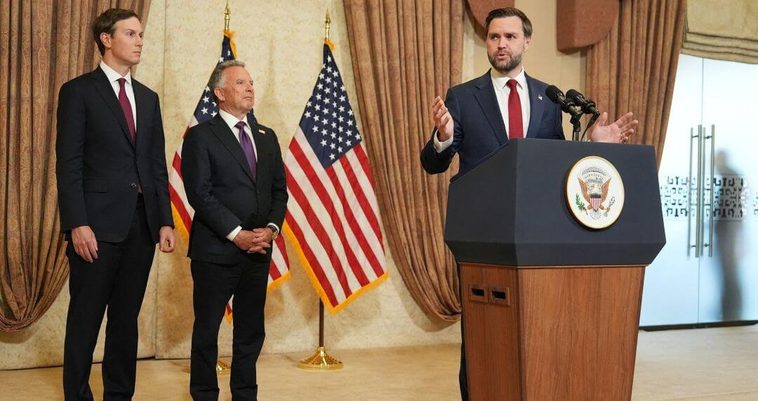
Leading the American delegation alongside special envoy Steve Witkoff and Jared Kushner, Vance emphasized that Washington had entered the negotiations with clearly defined boundaries. Those so-called “red lines” included strict limitations on Iran’s nuclear ambitions, constraints on its ballistic missile program, an end to support for terror-linked proxy groups, and guarantees tied to the security of the Strait of Hormuz—a critical artery for global energy markets.
According to Vance, those expectations were communicated in no uncertain terms.

“We’ve made very clear what our red lines are, what things we’re willing to accommodate them on, and what things we’re not willing to accommodate them on, and we’ve made that as clear as we possibly could,” Vance said. “Iran may have chosen not to accept our terms.”
When pressed by reporters to specify exactly where negotiations broke down, the vice president declined to go into detail, signaling a desire to keep sensitive diplomatic matters out of the public sphere—even after talks had ended.
“Well, I won’t go into all the details because I don’t want to negotiate in public after we negotiated for 21 hours in private,” Vance said. “But the simple fact is that we need to see an affirmative commitment that they will not seek a nuclear weapon, and they will not seek the tools that would enable them to quickly achieve a nuclear weapon. That is the core goal of the President of the United States, and that’s what we’ve tried to achieve through these negotiations.”

Despite the apparent breakdown, Vance stopped short of declaring diplomacy dead. Instead, he suggested that pressure—both economic and military—could eventually force Tehran back into serious discussions.
Throughout the press conference, Vance repeatedly emphasized one key point: the next move belongs to Iran.
“The Iranians decided not to accept our terms,” Vance reiterated, driving home the administration’s position that responsibility for the failure lies squarely with Tehran.
At the heart of the impasse is a fundamental issue that has defined U.S.-Iran relations for decades—whether Iran will make a verifiable, binding commitment to abandon any path toward nuclear weapons. According to Vance and supporting reports, Iran’s unwillingness to provide that assurance ultimately derailed progress.
The failed negotiations came on the heels of a recently announced two-week ceasefire, raising hopes that diplomacy might prevail. Instead, the outcome leaves uncertainty hanging over the region and raises fresh concerns about what comes next.
As the U.S. delegation prepares to return home, Vance made clear that American officials had followed through on their directive from Donald Trump.
“The President told us, you need to come here in good faith and make your best effort to get a deal. We did that, and unfortunately we weren’t able to make any headway,” Vance said.
WATCH VANCE’S FULL REMARKS HERE:
That statement echoes earlier warnings from Trump, who has repeatedly cautioned that failure to negotiate seriously could trigger severe consequences for the Iranian regime. With no deal in place and tensions still simmering, the stakes remain high—and the possibility of escalation is very much on the table.

