
>> Continued From the Previous Page <<
That statement alone should get Detroit’s attention.
For years, Hyundai’s presence in the truck space has been limited and underwhelming. The Santa Cruz, built on a unibody platform, failed to win over traditional truck buyers. Inventory piled up. Enthusiasm never followed. But the Boulder Concept is a sharp pivot away from that strategy. This is Hyundai admitting that if you want to compete in America, you have to play by American rules.

And that means building something that can take a beating.
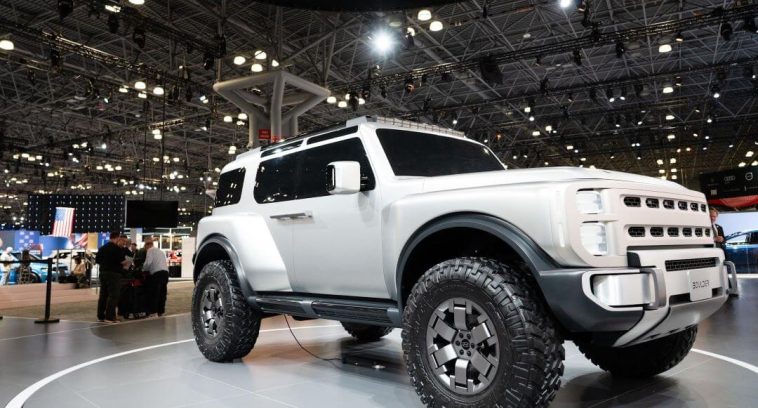
The Boulder looks exactly like what serious off-road buyers want. It rides on massive 37-inch mud-terrain tires. The stance is upright and aggressive. The body is squared off for maximum durability and visibility. Safari-style windows improve sightlines on trails. A heavy-duty roof rack adds real utility, not just style points. Even the tailgate is designed for function, with a dual-hinge system that opens in multiple directions.
Inside, Hyundai avoided the trap of over-digitizing everything. Instead of burying controls in giant touchscreens, the interior leans into practicality. Physical dials, thick and easy to grip, control critical systems like four-wheel drive and locking differentials. Multiple smaller displays replace the oversized screens that dominate modern dashboards. Built-in work surfaces and rugged grab handles make it clear this cabin was designed for use, not just for show.
This is not a lifestyle prop. It is a tool.
Hyundai is also making a strategic move that goes beyond design. The company confirmed the future production version of this platform will be developed and built in the United States using American-made steel. That decision is not just about logistics. It is about politics, economics, and perception.
By producing trucks domestically, Hyundai avoids the long-standing 25 percent tariff on imported light trucks, often called the “chicken tax.” More importantly, it gives Hyundai a powerful selling point to buyers who prioritize American manufacturing. It is a playbook that worked for Toyota when it built the Tacoma in Texas, and Hyundai is clearly following that model.
The timing is no accident.
The midsize truck and off-road SUV segment is one of the most fiercely competitive markets in the country. Brand loyalty runs deep. According to recent data, Ford owners stick with the brand at a remarkably high rate, while Toyota continues to dominate large portions of the midsize segment. Breaking into that circle is not easy.
But it is not impossible.
The return of the Bronco proved that American buyers still crave rugged, purpose-built vehicles. The success of the Jeep Wrangler over decades shows that capability still matters more than gimmicks. Hyundai appears to understand that lesson.
The Boulder Concept is not heading to dealerships tomorrow. It remains a concept for now. However, Hyundai has already outlined its long-term plan. A production pickup based on this platform is expected by 2030, with a similarly styled SUV variant likely to follow.
That gives Hyundai time to refine the product and position itself for a serious entry into the market.
The real story here is not just about one concept vehicle. It is about intent. Hyundai is signaling that it wants to compete head-to-head with America’s most iconic trucks, on their terms, in their home market.
Truck buyers may be loyal. But they are not blind.
And when a new challenger shows up with real capability, American manufacturing, and a clear mission, people start paying attention.
Hyundai just made sure it will not be ignored.

