
>> Continued From the Previous Page <<
But New York is only part of a much bigger story unfolding behind the scenes.
Another explosive case now sits before the Supreme Court, one that could redefine how race is considered in drawing congressional maps nationwide. The case, Louisiana v. Callais, centers on a Louisiana map that created a second majority-Black district after legal challenges. At its core, the dispute questions how far lawmakers can go in using race to shape electoral districts.

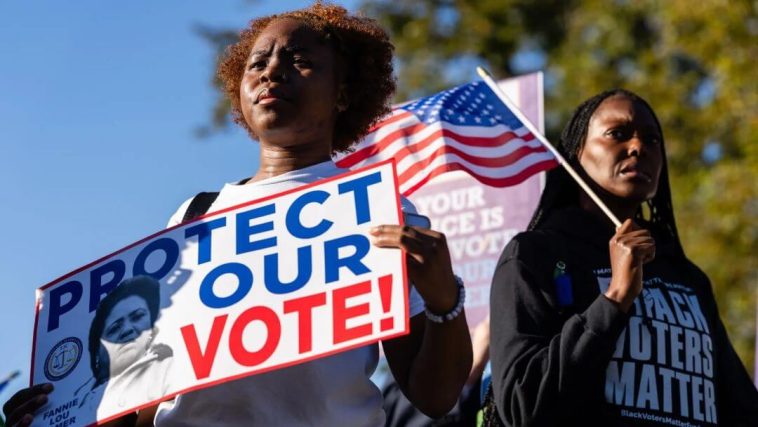
The legal fight revolves around a key provision of the Voting Rights Act of 1965, specifically Section 2, which allows citizens and advocacy groups to challenge maps they believe dilute minority voting power. For decades, this section has been one of the most powerful tools for reshaping districts across the country.
However, signals from the bench suggest the justices may be reconsidering how that tool is applied.
During arguments, members of the court explored whether drawing districts based on race could conflict with the Constitution’s equal protection guarantees. The tension between those principles has been building for years, especially after the landmark Shelby County v. Holder decision removed federal oversight requirements for certain states.
Since that ruling, battles over district maps have intensified, with both parties fighting for every advantage.
Chief Justice John Roberts, who previously authored the decision in Allen v. Milligan requiring a second majority-Black district in Alabama, appeared focused on maintaining consistency with earlier standards rather than completely rewriting the rules. That includes the long-standing framework from Thornburg v. Gingles, which sets conditions for proving minority vote dilution.
Meanwhile, Justice Brett Kavanaugh floated the idea of placing limits on how long race-based districting remedies can remain in effect, suggesting a possible “sunset” approach. Such a shift could dramatically alter how future cases are handled.
Voting rights groups aligned with Democrats are sounding the alarm, warning that weakening or eliminating Section 2 protections could open the door for widespread redistricting in Republican-controlled states. According to these organizations, as many as 19 districts could be redrawn in ways that favor GOP candidates.
Some analyses go even further, identifying up to 27 seats nationwide that could be reshaped depending on how the legal landscape evolves.
If those projections hold, the implications are massive. In a House of Representatives that has been narrowly divided in recent years, even a handful of favorable districts could cement long-term control for one party.
At the same time, Democrats in several states are beginning to explore countermeasures. Lawmakers like Zakiya Summers and Johnny DuPree in Mississippi are pushing proposals to create state-level versions of the Voting Rights Act, an effort to maintain protections regardless of how the Supreme Court rules.
For now, the country is left waiting.
What happens next inside the marble halls of the Supreme Court could ripple across dozens of congressional districts, shaping not just the next election cycle, but potentially the balance of power in Washington for years to come.

