
>> Continued From the Previous Page <<
In a 6-3 decision, Barrett and Neil Gorsuch joined the court’s three liberal justices and Chief Justice John Roberts in siding against the administration. The ruling rejected President Trump’s reliance on an emergency statute that he had invoked to carry out sweeping economic tariffs — a move his supporters viewed as essential to rebalancing trade and protecting American workers.
The president’s tariff plan had been framed as a bold effort to defend domestic industries from foreign competition and what he has long described as unfair trade practices. Trump argued that existing economic conditions constituted a national emergency, granting him authority under federal law to impose targeted tariffs without waiting on congressional approval.

But the Supreme Court disagreed.
In striking down the administration’s approach, the majority effectively blocked the mechanism Trump had selected to execute a strategy that has defined much of his economic agenda. For many on the right, the decision felt like a betrayal — particularly given Barrett’s appointment during Trump’s first term.
Barrett, nominated by President Trump in 2020 following the passing of Justice Ruth Bader Ginsburg, was widely celebrated by conservatives as a constitutional originalist. Her confirmation was hailed as a generational victory that would cement a strong conservative majority on the court for years to come.

Yet critics on the right argue that her recent rulings suggest a more independent streak than some anticipated.
This latest decision marks another instance in which Barrett has joined opinions that do not align neatly with the administration’s objectives. While supporters of the justice insist that her duty is to interpret the law — not to advance a political agenda — some conservative commentators have openly expressed frustration.
The ruling does not mean the end of the president’s tariff ambitions.
In fact, shortly after the Supreme Court’s decision, President Trump announced a revised approach. He unveiled a new 15% tariff plan, signaling that while the legal setback was significant, his broader economic mission remains firmly intact.
The announcement drew immediate attention from markets and lawmakers alike. Supporters applauded the president’s determination, arguing that strong trade measures are necessary to protect American manufacturing and national security. Critics, meanwhile, warned of potential ripple effects across global markets.
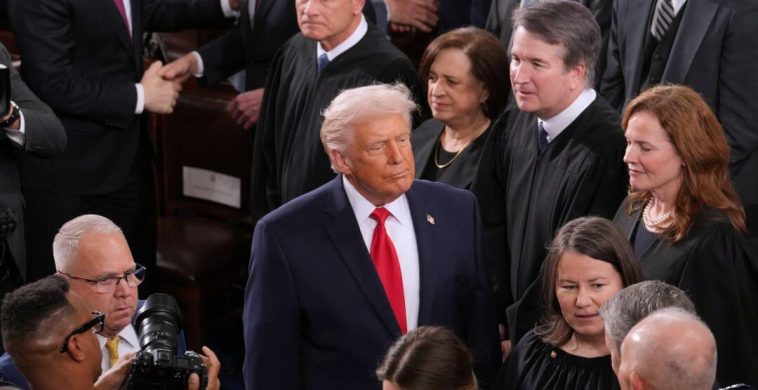
Inside the chamber during the State of the Union address, the contrast was striking.
As applause echoed through the hall and partisan divides were once again on display, the brief handshake between the president and Justice Barrett underscored the complex dynamics at play between two branches of government.
It was not an overt confrontation. There were no words exchanged publicly beyond the customary greeting.
But in Washington, symbolism often speaks louder than speeches.
The Supreme Court’s 6-3 decision — and the visible chill between the president and one of his own appointees — highlights an ongoing debate within conservative circles about judicial philosophy, executive authority, and the limits of emergency powers.
President Trump made no direct reference to the ruling during the opening moments of his address. Instead, he focused on economic strength, national security, and what he described as America’s resurgence on the world stage.
Yet the shadow of the court’s decision loomed large.
For supporters, the message was clear: the president intends to press forward with his economic agenda, court ruling or not. For critics, the episode reflects a healthy constitutional system in which even presidents must operate within defined legal boundaries.
Either way, the handshake — brief and businesslike — may come to symbolize a defining chapter in the ongoing relationship between the White House and the Supreme Court.
And as the administration pivots to implement its newly announced 15% tariffs, the battle over executive authority and economic strategy is far from over.

