
>> Continued From the Previous Page <<
The chatter gained momentum as analysts examined the political calendar. Some observers argue that a retirement announcement in the coming months—paired with a departure at the end of the Court’s term—could allow Republicans to move swiftly on a replacement, assuming the GOP maintains control of the Senate. Confirmation battles become far more complicated during the heat of an election season, and Senate Republicans may be reluctant to hold a contentious hearing in the fall.
That reality has fueled speculation echoed by another Strict Scrutiny co-host, Kate Shaw, who suggested Alito could announce plans to step down well before the next term concludes, giving senators room to act without campaign pressures dominating the process.

Adding another wrinkle to the discussion is Alito’s forthcoming book, scheduled for release in October, just as the Court begins a new term. That detail caught the attention of Steve Vladeck, a law professor at Georgetown University, who noted the logistical challenge of promoting a book while the Court is in session.
Vladeck described the timing as “a pretty big tell since one can’t exactly go on a book tour during the first argument session of the term.”
Recent history offers mixed signals. Justices Ketanji Brown Jackson and Amy Coney Barrett both released books in September, giving them space to promote their work before oral arguments began. That precedent suggests Alito’s October publication date could mean something—or nothing at all.
Legal commentator David Lat, however, offered a different interpretation. Writing on Substack, Lat argued that the later release might actually point toward Alito staying put.
“Book buyers are much more interested in what a current justice has to say, as opposed to a retired one,” Lat wrote. “I could see Justice Alito not wanting to step down until well after publication.”
Others caution against reading too much into timing alone. Washington consultant Bruce Mehlman recently observed that the current Court remains relatively young by historical standards, noting that the average retirement age in recent decades has hovered around 79. Alito, who turns 76 in April, remains below that benchmark.
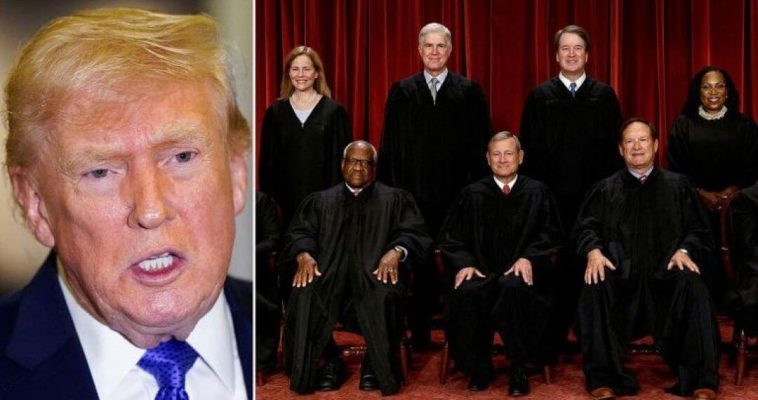
President Trump himself has weighed in on the broader retirement rumors in the past, expressing hope that Alito and fellow conservative Clarence Thomas continue serving. Trump has praised both justices as “fantastic,” even as he acknowledged ongoing speculation about possible vacancies.
The stakes are undeniably high. The Court’s 2025–26 term includes major cases involving federal agency authority, immigration enforcement, and foundational constitutional questions. Even a single change in the Court’s lineup could shape outcomes for decades.
Historically, Trump already ranks among the most consequential presidents when it comes to Supreme Court appointments. Since the 1950s, only Dwight Eisenhower, Richard Nixon, and Ronald Reagan appointed more justices than Trump, who selected Neil Gorsuch, Brett Kavanaugh, and Amy Coney Barrett.
If Alito were to retire, Trump would likely nominate a significantly younger conservative jurist—potentially locking in a right-leaning majority for a generation. For now, however, the justice has said nothing publicly, and Court officials report no scheduled announcements. Until that changes, the retirement talk remains just that—speculation—but speculation with enormous implications for the future of the Court and the country.

