
>> Continued From the Previous Page <<
Those artists are not hobbyists.
Each has a serious reputation in the contemporary art world, with work already selling in galleries and private collections independent of sports.

The uniforms themselves were then signed by players including Drake Maye, Sam Darnold, Jaxon Smith-Njigba, and Marshawn Lynch, adding direct on-field credibility to the artwork.
This is not your grandfather’s sports memorabilia.
Why Fanatics made the move now
Fanatics built its empire on licensed apparel and collectibles, generating $6.2 billion in commerce revenue in 2024 alone.
But the company’s leadership saw a problem.
While Fanatics dominated jerseys, hats, and trading cards, luxury collectors were quietly spending millions elsewhere. Traditional auction houses like Sotheby’s and Christie’s were cashing in on sports items that crossed into fine art territory.
The numbers are impossible to ignore.
The global collectibles market hit $283 billion in 2024 and is projected to reach $418 billion by 2032. Sports memorabilia alone is expected to more than double from $38 billion to $91 billion in the same time frame.
Fanatics Collectibles already owns the trading card space after acquiring Topps for $500 million. That division now brings in roughly $1.6 billion per year and is growing fast.
But one thing was missing. True one-of-one sports art.
Fanatics Fine Art fills that gap.
Artists with real cultural credibility
This project was not thrown together with generic designs or factory paint jobs.
King Saladeen brings bold, street-inspired visuals rooted in West Philadelphia culture.
Alex Alpert blends music industry storytelling with live art and large-scale murals.
JPO channels raw New York City energy through emotional, expressive works.
Cavier Coleman draws influence from Picasso and Basquiat while forging his own unmistakable style.
These artists sell work regardless of whether a football helmet is involved. That matters.
It signals that Fanatics is not selling novelty items. They are selling art that happens to be tied to sports history.
Perfect timing ahead of Super Bowl LX
The launch comes as Super Bowl LX draws massive national attention and as the Patriots make their first championship appearance since the post-Brady era began.
Fanatics is betting that wealthy sports fans are no longer satisfied with autographed balls and framed jerseys. They want cultural significance. Scarcity. Investment potential.
That bet is backed by recent results.
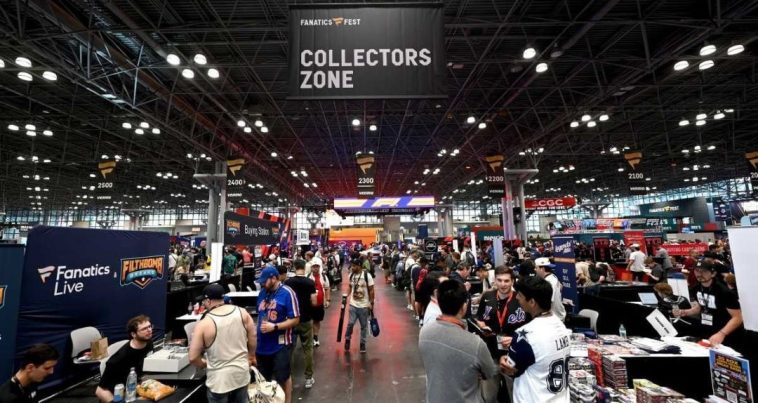
Fanatics Fest in 2025 drew 125,000 attendees and featured a $1.5 million display of game-worn jerseys from icons like Shohei Ohtani, Peyton Manning, and Johnny Unitas.
Collectors showed up. And they spent.
The message was clear. When sports memorabilia is presented as cultural history rather than fan merch, buyers treat it differently.
A bigger vision at work
This move fits neatly into CEO Michael Rubin’s broader strategy.
Fanatics is expanding into betting, live events, digital platforms, and now fine art. The goal is not just to sell a product, but to own the entire sports fan experience.
Buy the jersey. Bet on the game. Attend the event. Collect the card. Own the art.
The fine art launch confirms what serious collectors already understand.
At the highest level, sports memorabilia is no longer nostalgia. It is legitimate, culturally relevant art.
And with this Super Bowl move, Fanatics just made sure it will not be left behind while that market explodes.

