
>> Continued From the Previous Page <<
President Trump later acknowledged the meeting on Truth Social, writing:
“It was a Great Honor to meet Maria Corina Machado, of Venezuela, today,”
He continued:

“She is a wonderful woman who has been through so much. Maria presented me with her Nobel Peace Prize for the work I have done. Such a wonderful gesture of mutual respect,”
Machado framed the moment as a tribute to American support, explaining that the medal represented:
“a profound expression of gratitude for the invaluable support of President Trump and the United States for the Venezuelan people in this decisive struggle for our independence and the restoration of popular sovereignty.”
The Norwegian Nobel Committee, however, wasted no time distancing itself from the spectacle. Officials clarified that the prize itself cannot change hands, stating:
“Once a Nobel Prize is announced, it cannot be revoked, shared or transferred to others.”
While Trump did not receive the Nobel designation itself, the physical medal now reportedly remains in his possession—thanks to Machado’s calculated display.

A Political Message Disguised as Gratitude
Behind the smiles and symbolism, critics say Machado’s move was anything but selfless.
With Maduro captured and removed from power, President Trump has allowed Delcy Rodríguez to remain as Venezuela’s interim leader—a decision that reportedly angered entrenched globalist interests and elements of the foreign-policy establishment.
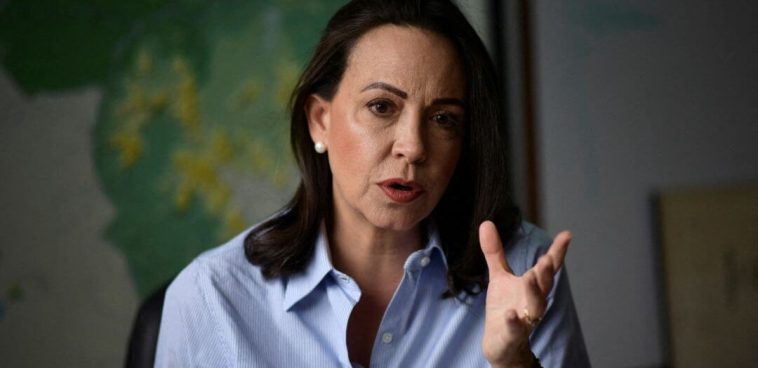
Machado, it appears, wants that position for herself.
Her Washington visit comes after years of political turmoil. Despite winning Venezuela’s opposition primary, Machado was blocked from appearing on the ballot by Maduro’s regime. In her place, Edmundo González ran as the opposition candidate and appeared to secure a decisive victory—only for the regime-controlled election authority to declare Maduro the winner anyway.
Facing arrest, Machado fled the country.
Now, with Maduro gone, she is back—not in Caracas, but in Washington—pressing President Trump to choose her as Venezuela’s next leader.
Delcy Rodríguez responded sharply on Thursday, making her displeasure clear during remarks to Venezuelan lawmakers.
“If one day, as acting president, I have to go to Washington, I will do so with my head held high, not on my knees,”
The message was unmistakable. Rodríguez sees Machado’s Nobel handoff not as humility, but as submission.
Desperation Is Not Leadership
For many observers, Machado’s decision to surrender her Nobel medal revealed more than she likely intended.
Rather than projecting confidence and independence, the move came across as a plea for political favor. In a nation desperate to rebuild after decades of socialist devastation, leadership demands strength—not spectacle.
Machado earned her Nobel Peace Prize through years of activism and advocacy. Turning that achievement into a bargaining chip risks reducing it to a campaign prop.
Venezuela’s future cannot be decided by who curries the most favor in Washington.
During her visit, Machado told U.S. lawmakers:
“I want to assure you that we are going to turn Venezuela into a free and safe country, and into the strongest ally the United States has ever had in this region — when Venezuela is free.”
Yet critics note she spoke as if her leadership were already a foregone conclusion.
That assumption underscores the deeper concern: Venezuela’s next leader must be chosen by Venezuelans, through transparent and lawful elections—not through symbolic gestures aimed at foreign power brokers.
Machado’s Nobel stunt may generate headlines, but it also raises serious doubts about her priorities.
Venezuela doesn’t need another politician fluent in Washington politics while disconnected from the streets of Caracas.
The nation needs steady hands, national resolve, and leadership earned through the will of the people—not through dramatic lobbying tours.
In the end, flashy gestures may impress elites, but they do not rebuild nations.

