
>> Continued From the Previous Page <<
“From the time I first began meeting with lawyers from the Manhattan DA’s Office and the New York Attorney General’s Office, I felt pressured and coerced to only provide information and testimony that would satisfy the government’s desire to build the cases against and secure a judgment and convictions against President Trump,” Cohen wrote.
Cohen admitted that he initially cooperated with prosecutors in hopes of improving his own legal situation after pleading guilty to federal crimes. But he claims that cooperation quickly crossed into coercion when his recollections did not align with what prosecutors wanted to hear.

“During my time with prosecutors, both in preparation for and during the trials, it was clear they were interested only in testimony from me that would enable them to convict President Trump. When my testimony was insufficient for a point the prosecution sought to make, prosecutors frequently asked inappropriate leading questions to elicit answers that supported their narrative,” he wrote in his Substack post.
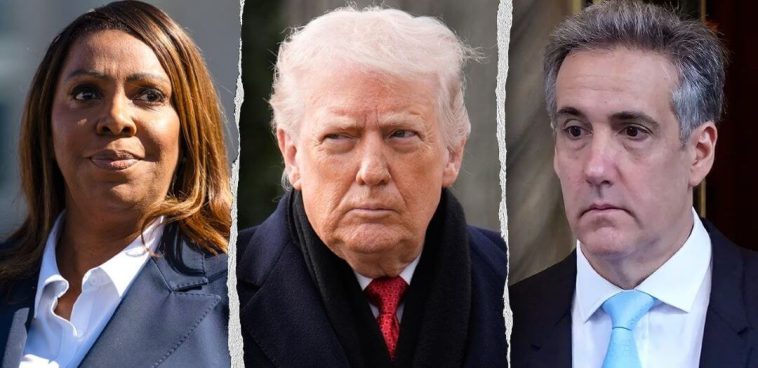
Cohen said the same dynamic played out in the civil fraud case brought by Attorney General Letitia James against Trump and the Trump Organization.
“I experienced a similar dynamic in the Attorney General’s civil case. Letitia James made it publicly known during her 2018 campaign for attorney general that, if elected, she would go after President Trump. Her office made clear that the testimony they wanted from me was testimony that would help them do just that. Again, I felt compelled and coerced to deliver what they were seeking,” he added.
Cohen did not stop there. He accused James and Manhattan District Attorney Alvin Bragg of operating from the same political playbook, using their offices to elevate their personal profiles by targeting Trump.
“Letitia James and Alvin Bragg may not share the same office or political calendar, but they share the same playbook. Both used their platforms to elevate their profiles, to claim the mantle of the officials who ‘took down Trump.’ In doing so, they blurred the line between justice and politics; and in that blur, the credibility of both suffered,” Cohen wrote, adding, “That context matters now more than ever.”
The timing of Cohen’s revelation is significant. His testimony helped fuel a civil fraud judgment against Trump that imposed massive financial penalties, a ruling that is now under appeal. He was also a central witness in Bragg’s hush money prosecution related to payments made during the 2016 campaign, a case that resulted in Trump’s 2024 conviction on 34 felony counts of falsifying business records.
Trump has consistently denied wrongdoing in all cases and has repeatedly warned that the prosecutions were politically motivated attempts to cripple his presidency and silence his supporters.
Cohen, who previously served more than a year in prison after pleading guilty to tax evasion, bank fraud, and lying to Congress, says his own experience inside the system drove him to speak out now.
“You may reasonably ask why I am speaking out now. The answer is simple,” Cohen wrote.
“I have witnessed firsthand the damage done when prosecutors pick their target first and then seek vidence to fit a predetermined narrative. I have lived inside that process,” he continued. “I have suffered from that process. My family has suffered from that process. And as courts now reconsider where the Bragg and James cases belong, how they were brought and how they were tried; that experience is relevant. More today than ever before.”
Cohen concluded with a warning that extends far beyond Trump or his own legal battles.
“Whatever the ultimate outcome of Trump’s cases, the larger lesson should not be lost,” he wrote. “Justice must be more than effective; it must be credible. When politics and prosecution become indistinguishable, public trust erodes; not just in individual cases, like mine and Trump’s, but in the system itself. That erosion serves no one, regardless of party, personality, or power.”
For critics of the New York prosecutions, Cohen’s confession only reinforces what conservatives have argued for years. Trump was not investigated because of evidence. He was targeted first, and the evidence was assembled afterward.

