
>> Continued From the Previous Page <<
Back in May 2021, the Kareliya pulled a similar stunt off Kauai, forcing the U.S. Navy to delay missile-defense tests at the Pacific Missile Range Facility. Biden’s Pentagon watched Russia loiter near critical defense test sites and chose the same strategy they always choose — look concerned, release a memo, and hope it goes away.
By January 2023, things got even more absurd. Russian spy vessels were tracked for weeks as they refueled at sea roughly 100 miles off Hawaii. Biden’s response? More bureaucratic jargon about “monitoring” and conducting “safe and professional” overflights while Moscow collected high-value intelligence on submarine activity, missile systems, and Pacific Fleet operations.

The message was unmistakable: the Biden administration wouldn’t act.
Putin noticed.
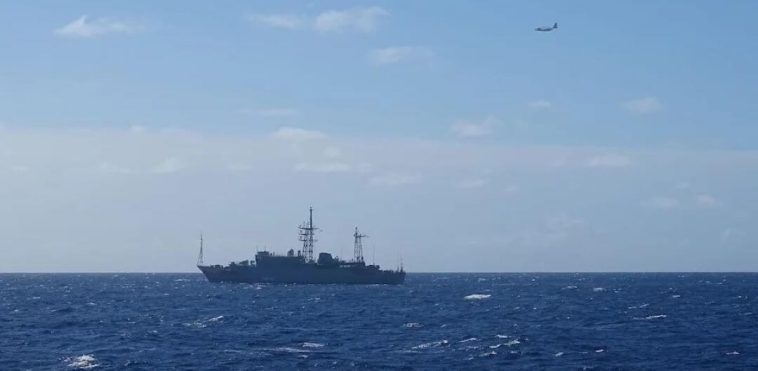
The Kareliya is no relic. Despite being built in the Soviet era, it’s loaded with advanced signal-collection systems designed to capture communications, track naval movements, and harvest electronic intelligence. Russia operates seven ships in this class, each a dedicated surveillance platform.

The vessel underwent a major modernization that finished in 2017, leaving it far more capable than the aging hull would suggest.
Putin isn’t sightseeing. He’s collecting data that feeds directly into Russian and Chinese military strategy — everything from missile-defense architecture to satellite-communication patterns.
And he remains bold enough to park this thing near Hawaii because Biden proved for four straight years that America wouldn’t stop him.
Here’s the key context: Trump is hitting Russia where it hurts.
He has already leveled severe penalties on energy giants Rosneft and Lukoil — punishments Biden never had the political will to issue. European nations are scrambling. Bulgaria moved to nationalize a Lukoil refinery to escape secondary sanctions. Major producers in Iraq invoked force majeure rather than risk violating Trump’s restrictions. And Trump has openly threatened 25% tariffs on any country caught importing Russian crude.
This is the kind of pressure that disrupts Moscow’s finances — and it’s exactly why Putin is testing boundaries again.
Old habits die hard. For years, Biden let Russia park spy ships near Hawaii without pushback. Putin wants to know if Trump’s toughness is temporary or permanent.
Yes, the Coast Guard points out that foreign military ships may operate beyond the 12-mile limit under international law. That’s technically correct — and strategically meaningless.
During the Cold War, the Soviets constantly probed the United States until Ronald Reagan made it clear their games wouldn’t fly. After the USSR collapsed, these operations dwindled because Moscow respected American strength.
Biden reversed that progress in four years.
Today, Russia is gathering intelligence on Indo-Pacific Command, the Third Marine Littoral Regiment, and the Pacific Missile Range Facility — all essential in any confrontation with China. Every signal Russia intercepts becomes intel Beijing can exploit.
The spy ship off Hawaii isn’t just collecting data. It’s a direct challenge.
Putin wants to know if Trump will accept the “monitor and observe” approach that defined Biden’s foreign policy — or if the United States will finally re-establish consequences.
Trump’s sanctions are already damaging Russia’s economy. But reshaping Putin’s behavior takes more than a few months of strength after four years of weakness.
The question now is simple: Will Putin learn the era of free passes is over?
Right now, that spy ship is waiting for the answer.

