

>> Continued From the Previous Page <<
The report underscores how the creation of the original ICA was unlike anything standard in intelligence practice. Rather than allowing career analysts to operate independently, agency heads like Brennan, Comey, and Clapper took center stage, injecting themselves into the drafting process in a way that was described as “highly unusual in both scope and intensity” and that “risked stifling analytic debate.”
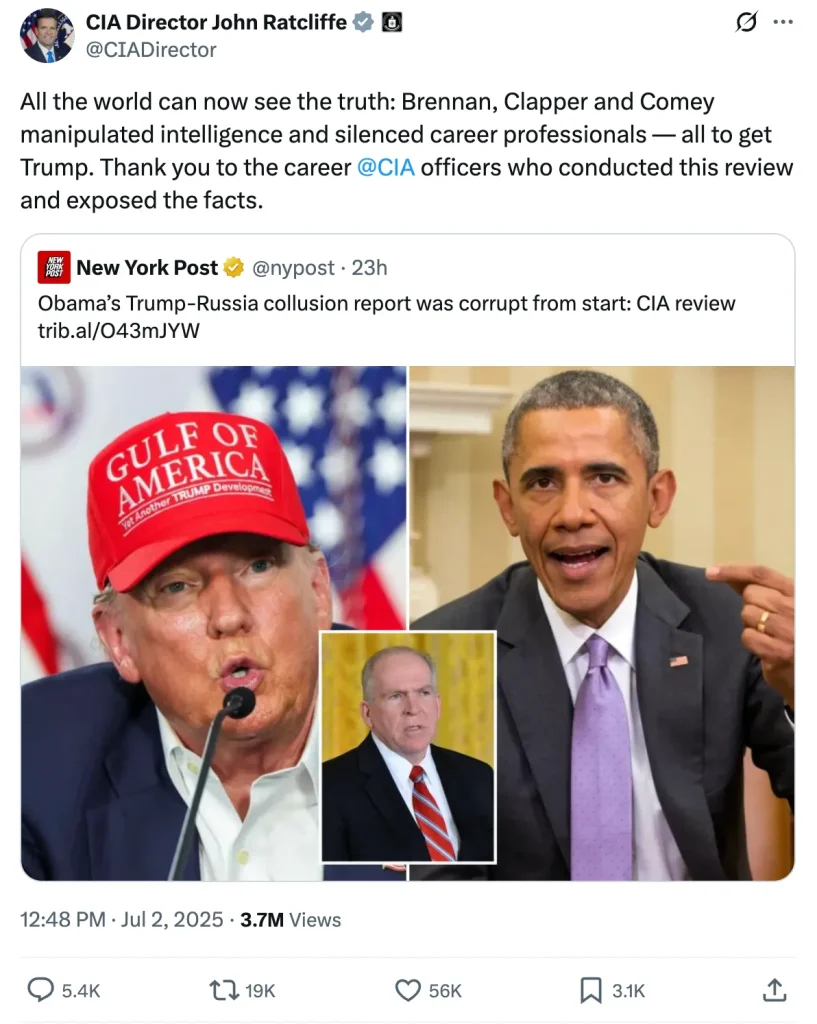
Even worse, Brennan reportedly kept 13 of the 17 U.S. intelligence agencies out of the assessment altogether, including the National Security Council. The report claims Brennan limited the process to just the CIA, FBI, NSA, and Office of the Director of National Intelligence — a move that narrowed the field of input and criticism at a time when transparency was critical.

Perhaps the most damning revelation involves the now-discredited Steele dossier. Analysts had strongly advised against including it in the ICA, but Brennan overrode those objections.
“CIA’s Deputy Director for Analysis (DDA) warned in an email to Brennan on December 29 that including it in any form risked ‘the credibility of the entire paper.’”
Still, Brennan pressed forward, replying, “My bottom line is that I believe that the information warrants inclusion in the report.”
The review didn’t mince words when it described Brennan’s motivation: a clear “preference for narrative consistency over analytical soundness.” In other words, he seemed more interested in backing a political storyline than ensuring intelligence accuracy.
The report also confirmed that FBI leadership, under Comey, insisted the Steele dossier be woven into the body of the ICA. According to the findings, “FBI leadership made it clear that their participation in the ICA hinged on the Dossier’s inclusion and, over the next few days, repeatedly pushed to weave references to it throughout the main body of the ICA.”
Even though a two-page annex was created to separate the Steele dossier from the main conclusions, the damage was already done. The ICA placed a reference to the annex material in a key section that supported the judgment that Putin helped Trump, effectively giving unverified claims the same weight as vetted intelligence.
Ratcliffe didn’t hold back in his assessment of the Obama-era intel chiefs. “This was Obama, Comey, Clapper and Brennan deciding ‘We’re going to screw Trump,’” he told the New York Post in an exclusive interview.
“It was, ‘We’re going to create this and put the imprimatur of an IC assessment in a way that nobody can question it.’ They stamped it as Russian collusion and then classified it so nobody could see it.”
Ratcliffe noted the political fallout: “This led to Mueller [special counsel Robert Mueller’s inquiry, which concluded after two years that there was no Trump-Russia collusion]. It put the seal of approval of the intelligence community that Russia was helping Trump and that the Steele dossier was the scandal of our lifetime. It ate up the first two years of his [Trump’s first] presidency.”
In short, this report paints a devastating picture: career intelligence officials were sidelined, the process was manipulated, and unverified political dirt was packaged as official intelligence to damage a presidential candidate — and later, a sitting president.
The final takeaway from Ratcliffe’s review is chilling: “With analysts operating under severe time constraints, limited information sharing, and heightened senior-level scrutiny, several aspects of tradecraft rigor were compromised — particularly in supporting the judgment that Putin ‘aspired’ to help Trump win.”
This revelation calls into question the very foundation of the years-long Russia collusion narrative — and shines a harsh spotlight on the dangerous politicization of America’s most powerful intelligence agencies.

